On 8 July, a fire tore through the Springwood unit at Malton Hospital in North Yorkshire, destroying the building and forcing the evacuation of fifteen patients from a mental health ward. Two weeks later, the fire service named the likely source: one of the solar panels on the roof.
If you are responsible for a commercial or public sector building with solar PV on it, that headline lands differently than it does for everyone else. Across Suffolk, around 80 schools responded by switching their panels off entirely. It is an understandable reaction. It is also, in most cases, the wrong one.
The uncomfortable truth is that solar panels can cause fires. The more useful truth is that they almost never do, and when they do, the panels themselves are rarely at fault. UK government investigations point overwhelmingly to a small number of electrical components on the DC side of the system, and to one root cause above all others: how the system was installed and whether anyone has looked at it since.
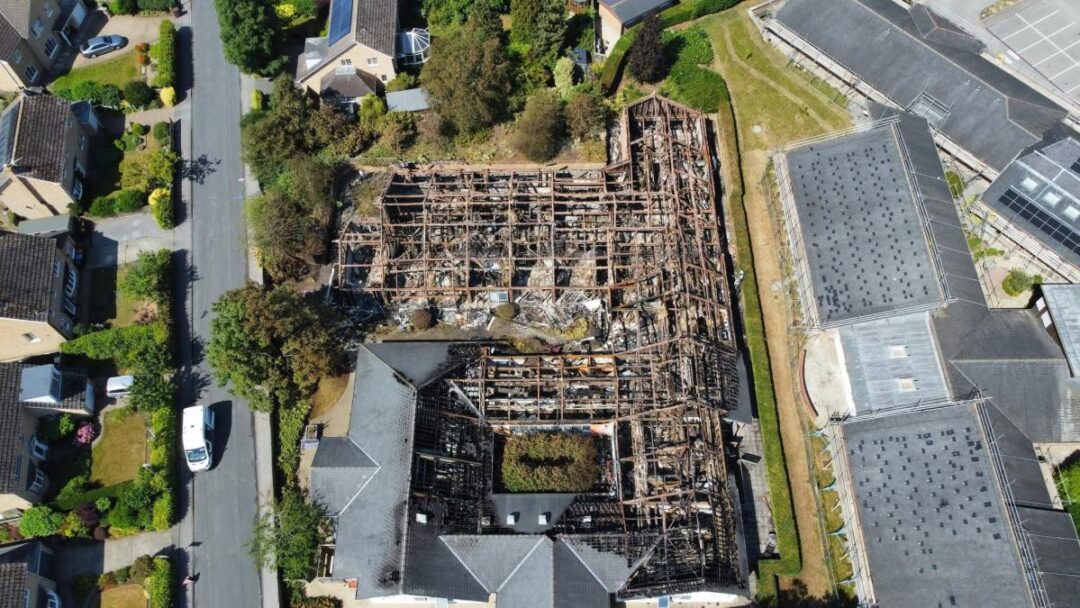
An aerial view showing the extent of the damage following a fire at Malton Hospital, reportedly linked to solar panels. Photo by Mark Wilson.
Can solar panels cause fires?
Yes, solar panels can cause fires, but it is rare, and the panels themselves are almost never the fault. UK government research found that the majority of solar PV fires start on the direct current (DC) side of the system, most often at isolators and connectors, and that poor installation is the single largest root cause. Fires linked to solar PV are estimated at roughly 5 to 22 incidents per 100,000 installations in the UK. Good design, certified installation and scheduled maintenance remove most of the risk.
What happened at Malton Hospital?
Solar panels have been named as the likely cause of a fire that destroyed a mental health ward at a North Yorkshire hospital. As BBC News reported, the Springwood unit at Malton Hospital, which provides mental health services for older people, went up in flames on 8 July and the building was completely destroyed.
Tees, Esk and Wear Valleys NHS Foundation Trust confirmed its investigation was ongoing. According to ITV News Calendar, the trust said North Yorkshire Fire and Rescue Service had established the fire most likely started at one of the solar panels on the roof, and that the damage sustained by those panels during the fire made further detail impossible to determine. Euronews reports that all 15 patients were safely evacuated with no injuries.
It is not an isolated headline. A blaze that forced the evacuation of a Bristol maternity hospital was later confirmed by Avon Fire and Rescue Service as accidental and caused by a fault in the solar panels on the roof. Three primary school fires in England over a twelve month period were also blamed on solar panels, which,according to Euronews, led around 80 schools in Suffolk to switch their panels off as a precaution, although the council indicated the school fires were believed to have separate causes rather than one common fault.
The reasonable question for any facilities director, estates manager or trustee reading that is not “is solar dangerous” but “what is the actual failure mode, and is my site exposed to it”.
How common are solar panel fires in the UK?
Rare, but not zero. The most authoritative UK dataset remains the Building Research Establishment report commissioned by the government, Fire and Solar PV Systems: Investigations and Evidence.
Of the 80 solar panel fire incidents investigated, 58 were directly caused by the PV system, with 22 of those leading to serious fires and 27 to localised fires. A further 16 involved PV but were not directly caused by it. Those 80 reported faults sat against a UK installed base of roughly 940,000 PV installations at the time.
International comparisons point the same way. Research from Germany’s Fraunhofer ISE, summarised by Euronews, found that 0.006 per cent of PV installations caused a fire with major damage between 1993 and 2013. Of Germany’s 1.3 million PV installations in 2013, 350 were involved in fires and 120 were attributed as the actual cause. A more recent four-country European study found approximately 5 to 22 incidents per 100,000 installations in the UK, Italy and Sweden.
What actually causes solar panel fires?
This is where the headline and the engineering diverge. The modules on your roof are rarely the problem. The electrical components that connect them are.
DC isolators are the leading fire origin
DC isolators presented the greatest fire risk in the BRE study, identified as the probable cause of 26 of the 80 fires and attributed to poorly designed and installed isolators. DC connectors were the second major risk. The most likely ignition mechanism was electrical arcing, where current flows across an air gap through ionised gas and becomes hot enough to cause combustion.
Older designs mounted the DC isolator externally to the inverter, meaning it had to be assembled by the installer on site. Modern inverters increasingly integrate DC isolation, which removes a set of field-made connections and is the safer design.
Installation quality is the dominant root cause
As Solar Power Portal reported on the government findings, more than a third of fires (36 per cent) were attributed directly to problematic installations, with 12 per cent down to faulty products and 5 per cent to system design. The remaining 47 per cent could not be attributed. DC isolators were linked to as many as 18 incidents, DC connectors a further 10, and inverters as many as seven.
BRE’s own guidance makes the same point: building fires where PV systems were the cause have generally resulted from poor installation or the use of wrongly specified, incorrect or faulty equipment. One documented example is AC isolator switches being used mistakenly in DC circuits, causing heat to build up in the switch.
Defects are far more widespread than fires
An audit by Clean Energy Associates of more than 600 rooftop PV systems across 14 countries in 2023 found that 97 per cent exhibited a defect of some kind. Most defects are performance issues rather than fire hazards, but the figure tells you something important: an unmonitored, uninspected commercial array is very likely carrying faults you do not know about.
Why commercial rooftop solar carries higher stakes?
A domestic 4 kWp array and a 2 MWp warehouse roof are not the same risk profile. Commercial systems involve far more string cabling, more connectors, more combiner boxes and more isolation points, which means more potential arc sites. They also sit on roof build-ups that may include combustible insulation or membranes, and they sit above operations that cannot simply pause.
For a hospital, a school or a distribution centre, the consequential loss is rarely the array. It is the ward, the term, or the fulfilment window.
There is also a firefighting dimension. As BRE explains, inverters shut down automatically when the AC supply fails, but the DC supply from the panels to the DC isolator remains live during daylight. If a fire damages DC cables and burns off insulation, exposed conductors present an electric shock risk, particularly to firefighters. This is why signage, isolation strategy and a shared emergency plan are not paperwork exercises.
How to prevent solar panel fires?
Fire risk is created at three stages, and it is removed at the same three stages.
1. Design out the risk
- Specify inverters with integrated DC isolation rather than adding separate external isolators wherever the design allows. Extra switches mean extra contacts, connectors and failure points.
- Avoid siting DC isolation under arrays, behind modules, in loft voids, or anywhere water can track in, such as beneath gutters and drip lines.
- Use bottom-entry cable glands outdoors to reduce water ingress.
- Match connector brands. Never cross-mate look-alike connectors from different manufacturers.
- Apply array set-backs from roof edges and firebreak zones, and consider the roof build-up beneath the array, not just the array itself.
- Include a fire risk assessment by a competent person as part of the design package.
Our renewable energy consultancy team builds these decisions into feasibility and design stage, before anything is procured.
2. Install to standard, with accountability
- Use an accredited, MCS-certified contractor with in-house electrical capability rather than a subcontracted chain where nobody owns the DC terminations.
- Insist on correct crimping tools for the connector system specified. Field-fabricated connectors made with the wrong tool are a documented fire origin.
- Require torque records on terminations and full commissioning documentation, including string test results, insulation resistance and IV curve data.
- Ensure DNO notification obligations under G98 or G99 are met, including for later inverter replacements.
Our installation service covers procurement, mechanical and electrical works, testing, commissioning and handover documentation under one accountable contract.
3. Maintain and monitor for life
This is where most commercial sites are exposed. A system installed correctly in 2016 and untouched since is not a low-risk system.
- Annual servicing at minimum. Insurers increasingly require it. Read our guide on how often businesses should schedule commercial solar maintenance.
- Thermographic inspection. Infrared surveys find hot joints, failing connectors and degrading isolators before they arc. Nothing else finds them as reliably.
- Live performance monitoring. A string that quietly drops out is a fault signal, not just a yield loss.
- Visual inspection of enclosures. Water staining, corrosion, discolouration and heat marking around terminals are early warnings.
- Vegetation, debris and pest control. Birds nesting under arrays chew cables and pack the gap with combustible material.
- Re-inspection after any roof works. Other trades on the roof are a common source of mechanical cable damage.
Our aftercare and optimisation services cover monitoring, fault diagnosis, repair and repowering, and you can estimate ongoing servicing costs with our maintenance calculator.
What RC62 requires from commercial solar installations?
If you own or specify commercial rooftop PV in the UK, RC62 is the document your insurer will reference.
RISCAuthority, the Microgeneration Certification Scheme and Solar Energy UK jointly updated RC62, Recommendations for fire safety with photovoltaic panel installations, into a freely available Joint Code of Practice. As Solar Energy UK explains, it focuses on fire safety for commercial and industrial rooftop mounted PV, providing a practical guide for insurers and their clients on the procurement, ownership, operation and maintenance of safe and efficient PV systems. The guidance and its accompanying checklist can be downloaded from MCS.
In the absence of statutory guidance, insurers have effectively shaped fire safety standards for building-applied PV. RICS notes that RC62, alongside prescriptive standards from individual insurers, sets recommendations covering installation, material selection and system design, typically including maximum array sizes, minimum offset distances such as clearance between roof edge and panels, and non-combustible materials beneath PV systems.
Practically, this means fire safety is now a commercial condition, not just an engineering preference. Non-compliance can affect cover, premiums and claims. It is also a moving target: the National Federation of Roofing Contractors and partners have published a position paper calling for a more risk-based interpretation for flat roofs, and RISCAuthority has opened a consultation with a view to updating the guidance.
Should you switch your solar panels off?
Switching off an entire estate is an understandable first reaction, and it is what happened across a group of Suffolk schools. It is rarely the right long-term answer.
Turning a system off removes generation, removes savings, removes carbon benefit, and does not fix an underlying defect. It also does not fully de-energise the array. The DC side remains live during daylight regardless of what the AC breaker is doing. The proportionate response is an inspection-led one:
- Commission a thermographic and electrical inspection of the array, isolators, connectors and inverters.
- Check whether external DC isolators are present, what condition they are in, and whether they are correctly rated and weatherproofed.
- Review commissioning records and any service history.
- Remediate what is found, then return the system to service under a maintenance regime.
For public sector estates, our sector pages for hospitals and healthcare centres, schools, colleges and universities and public sector buildings set out how we handle estates with occupancy and continuity constraints.
Warning signs your solar PV system may be a fire risk
Report any of the following to a qualified contractor without delay:
- Burning or acrid smell near the inverter or isolator enclosures
- Discolouration, scorching or melting around terminals, connectors or switch housings
- Tripping breakers, repeated insulation resistance faults or recurring inverter earth fault alarms
- Sudden or unexplained drop in output from one string
- Buzzing, crackling or humming from DC enclosures
- Water staining or corrosion inside outdoor enclosures
- Any inverter error codes left unresolved for weeks
Critically, do not open anything on the DC side yourself. It cannot be switched off in daylight. Our guide on how to identify when your solar panels need professional servicing covers what is safe to check from the ground.
How EvoEnergy helps businesses reduce solar fire risk?
EvoEnergy has delivered commercial renewable energy since 2007, with over 10,000 projects completed and more than 3,500 assets under management across the UK, including sites for Aldi, Birmingham Airport, DPD, the Royal Mint and NHS estates. We are a full turnkey provider, which matters here more than it sounds: design, procurement, electrical installation, commissioning and long-term maintenance sit with one accountable team rather than a subcontract chain where DC terminations belong to nobody.
Where we can help:
- Consultancy and feasibility: fire-conscious system design, isolation strategy, roof build-up assessment and insurer-aligned specification.
- Installation: in-house accredited electrical delivery with full testing, commissioning and handover documentation.
- Aftercare and asset management: planned servicing, thermographic inspection, monitoring, fault diagnosis and repair across owned and inherited assets.
- Optimisation and repowering: upgrading legacy systems, including replacing ageing external DC isolators with safer integrated designs.
- Rooftop solar PV: custom-engineered commercial arrays designed around your roof, not a template.
If you have inherited a system, if it has never been thermally surveyed, or if your insurer has started asking about RC62, an inspection is the sensible next step. Make an enquiry and we will scope it.
The safest solar system is the one someone is still looking after
Solar panels do not fail because they are solar panels. They fail because a connector was crimped with the wrong tool, an isolator let water in, or nobody had been up to the roof since commissioning. Every one of those is preventable, and none of them is prevented by hoping.
The headlines out of Malton, Bristol and Suffolk are not an argument against commercial solar. They are an argument against unowned solar: systems bought on price, installed by whoever was cheapest that quarter, and then left alone for a decade while the savings quietly rolled in and the terminations quietly degraded.
If you are specifying a new system, the fire risk is designed out now, at feasibility stage, not retrofitted later. If you already have one, the question is simply when it was last inspected properly, and whether anyone has ever put a thermal camera on the DC side.
Get your solar PV system assessed by an accredited team. Whether you need a fire risk and thermographic inspection on an existing array, a second opinion on an inherited asset, or a new commercial rooftop solar system designed to insure standards from day one, our engineers can scope it.
Make an enquiry or call 0844 815 0200 to speak to the team about an inspection, a service plan through our aftercare services, or a fire-conscious design through our consultancy service.