As the UK accelerates toward its net zero targets, commercial solar power has transitioned from an ambitious sustainability initiative into a core corporate asset. Across industrial factories, cold storage warehouses, logistics hubs, and agricultural outbuildings, thousands of businesses have covered their rooftops with photovoltaic (PV) arrays to stabilise long term energy costs and mitigate volatile energy markets.
However, a significant milestone is approaching for the UK renewable energy sector. The earliest waves of large scale commercial installations, heavily incentivised by the original Feed in Tariff schemes of the early 2010s, are beginning to approach their mid life upgrades, repowering phases, or ultimate decommissioning cycles. This shift brings a critical, highly regulated operational requirement into focus: recycling solar panels.
For forward thinking commercial landlords, sustainability officers, and operations directors, understanding the legalities, logistics, and corporate responsibilities of decommissioning solar assets is no longer a future consideration. It is an immediate compliance priority.
Why UK Businesses Must Understand Recycling Solar Panels and Legal Compliance?
A common misconception is that decommissioning green infrastructure is a casual disposal task. Under UK legislation, solar PV panels are strictly classified as non household electronic waste. Consequently, your business cannot simply dispose of them in standard commercial skips, clear them via unlicensed scrap dealers, or mix them with general industrial waste.
The WEEE Regulations Framework
The primary legislation governing solar disposal in the UK is the Waste Electrical and Electronic Equipment (WEEE) Regulations. Under this legal framework, photovoltaic panels are designated as Category 14 electronic waste. This classification enforces a rigorous “cradle to grave” responsibility on both the producers of the technology and the commercial end users.
To achieve compliance, all decommissioned commercial panels must be collected by a licensed waste carrier and transported directly to an Approved Authorised Treatment Facility (AATF). These specialised plants possess the certified technology required to treat, process, and track the recovery percentages mandated by the Environment Agency.
| Commercial WEEE Compliance Pathway |
1. Asset Audit
Identify panel dates & producers
|
2. Licensed Carrier
Transport via secure, WEEE licensed logistics
|
3. AATF Facility
Certified recovery & official receipt
|
|
Critical Document:
Duty of Care Waste Transfer Note (2-Year Hold)
|
Legal Liabilities and Corporate Penalties
Failing to maintain a flawless regulatory paper trail carries severe consequences. If your business allows an unaccredited contractor to dismantle and dispose of an array, you remain legally liable under environmental protection laws.
Non compliance can result in:
- Unlimited statutory fines issued by the Environment Agency or local authorities.
- Formal environmental audits that can disrupt daily business operations.
- Irreparable damage to corporate reputation, which directly undermines broader corporate sustainability claims.
To protect your business, every single decommissioning project must be validated with an official Duty of Care Waste Transfer Note. By law, your company must retain these records for a minimum of two years to verify compliance during internal audits or external ESG inspections.

How Does the Process for Recycling Solar Panels Actually Work?
A standard commercial solar panel is built to withstand decades of harsh weather. This durability stems from a complex, multi-layered lamination process that seals the silicon cells. Undoing this industrial lamination requires advanced technical processing at dedicated infrastructure facilities to maximise material recovery.
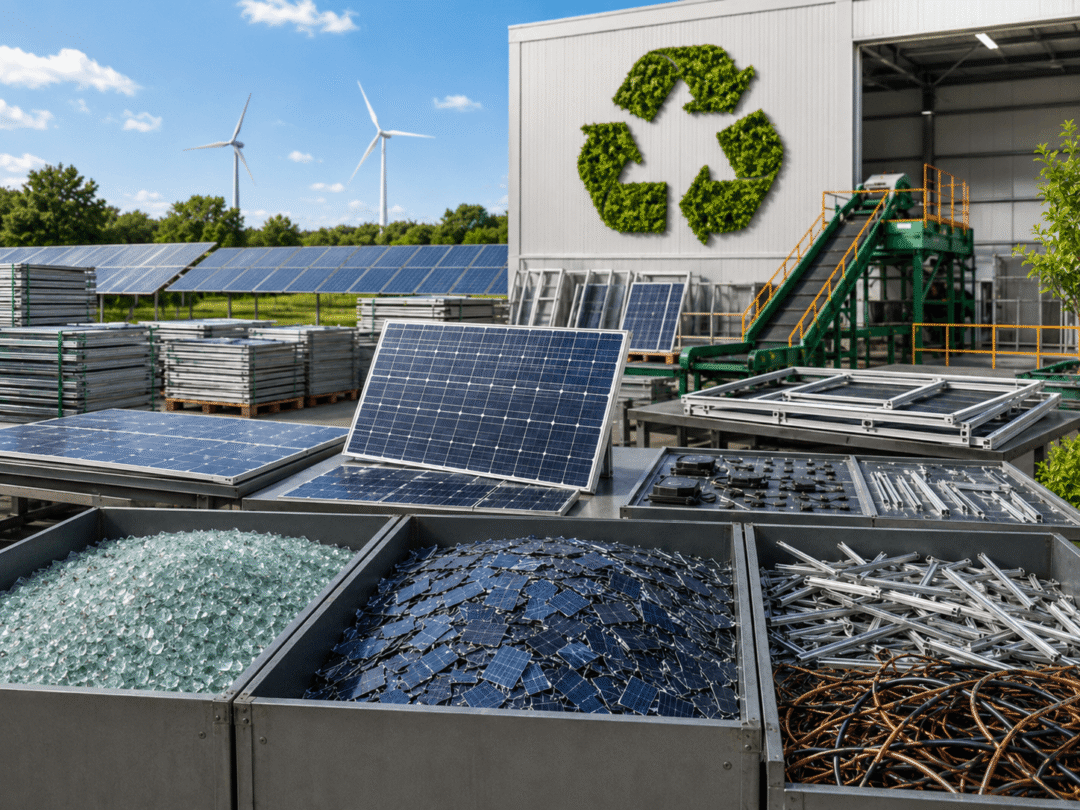
A typical silicon based solar panel is composed of roughly 75% glass, 10% aluminium, 10% polymer plastics, and 5% silicon wafers and trace metals like silver and copper. The recycling process uses mechanical, thermal, and chemical processing to separate these valuable resources.
Step 1: Decommissioning and Specialist Logistics
The cycle begins on site. Certified electrical engineers carefully isolate, decouple, and unmount the array. Maintaining module structural integrity during this phase is vital. Broken glass contaminates the pure silicon layers beneath, which substantially lowers the overall recycling value and drives up processing costs.
Step 2: Mechanical Stripping
Once the panels arrive at an AATF, the exterior components are manually or mechanically detached. The outer aluminium frame is unbolted, and the copper heavy electrical junction boxes are clipped away. Both components are 100% recyclable and are immediately diverted back into standard metals manufacturing loops.
Step 3: Pyrolysis (Thermal Processing)
The remaining laminated module consists of glass, silicon cells, and an insulating polymer plastic film called Ethylene Vinyl Acetate (EVA). To break this strong bond, the modules pass through a specialised high temperature oven operating at approximately 500°C. This thermal processing vaporises the plastic layers, leaving the glass sheet separated from the underlying silicon wafers.
Step 4: Chemical Refinement and Purification
The final stage targets the exposed silicon cells. The recovered wafers are treated via chemical etching and rotating leach drums containing precise acid solutions. This process isolates and extracts high purity silicon along with trace amounts of valuable copper and silver. The purified silicon is then melted down to be cast into new wafers for future electronics production.
| Solar Panel Material Recovery Matrix |
| Material |
Weight % |
Recycling Method |
Secondary Market |
| Aluminium Frame |
-10% |
Mechanical Stripping |
Metal Extrusion |
| Junction Boxes |
-2% |
Cable Shredding |
Copper Smelting |
| Front Glass |
-75% |
Pyrolysis / Milling |
Cullet / Fiber |
| Silicon Wafers |
-4% |
Chemical Etching |
New Semiconductors |
| Precious Metals |
<1% |
Hydrometallurgical |
Industrial Silver |
Who Bears the Cost of Decommissioning and Recycling Solar Panels?
Determining who is financially responsible for the end of life costs of a commercial solar asset depends heavily on the initial equipment procurement date and the specific terms outlined in your original supply contract.
The Impact of the August 2005 Threshold
The UK WEEE Regulations use a historical boundary line to assign financial liability for electronic waste disposal:
- Panels Purchased After 13 August 2005: Under the Extended Producer Responsibility (EPR) mandate, the manufacturer or importer (the “Producer”) who placed the solar panels onto the UK market is legally responsible for financing their collection, treatment, and recycling. Producers typically fulfil this obligation by paying into a certified Producer Compliance Scheme (PCS), such as PV CYCLE.
- Panels Purchased Before 13 August 2005: These components are legally classified as “historic waste.” If you are replacing these panels with a brand new solar system, the provider of the replacement equipment is often required to absorb the historic disposal costs. However, if you are simply removing a historic array without replacing it, the financial liability rests entirely with the business owning the asset.
Understanding the Total Cost Breakdown
While the actual processing fees at an AATF may be covered or heavily subsidised by a manufacturer’s compliance scheme, businesses must understand that “free recycling” does not mean “free decommissioning.”
Your organisation will still need to allocate budget for the physical labor, safety scaffolding, roof edge protection, electrical isolation, and specialised WEEE freight logistics required to safely transport the units from your roof to the processing facility.
A Practical Checklist for Asset Owners
Managing an end of life commercial solar asset requires careful operational planning. Use this technical checklist to ensure your decommissioning project remains fully compliant, safe, and efficient.
- Execute a System Audit: Document the manufacturer name, model numbers, installation date, and total volume of panels across your facility.
- Review Original Supply Contracts: Check if the original installer or hardware producer included pre funded WEEE take back clauses or an active Producer Compliance Scheme registration.
- Verify Installer Accreditations: When appointing a partner to manage system removal, ensure they hold robust health and safety credentials alongside specialised commercial solar experience.
- Confirm WEEE Carrier Status: Demand written proof that the logistics provider moving the decommissioned assets holds a valid Environment Agency Waste Carrier License.
- Identify the End Destination: Ensure the final processing destination is an officially registered Approved Authorised Treatment Facility (AATF).
- Secure and File All Evidence Notes: Collect the official Waste Transfer Notes and WEEE Evidence Notes immediately upon completion, storing them securely for at least two years to fulfill your corporate Duty of Care.
Partner With EvoEnergy for Compliant Commercial Solar Lifecycle Management
The long term sustainability of renewable infrastructure depends entirely on how we manage these systems at the end of their operational lifespan. Decommissioning and recycling solar panels shouldn’t be treated as an isolated waste disposal problem. Instead, it represents the final stage of a responsible, highly integrated corporate energy strategy.
As an industry leading renewable energy specialist, EvoEnergy provides a complete turnkey service that covers the entire lifetime of your sustainable infrastructure. Our expert team combines deep technical knowledge with strategic energy advisory services, helping organisations design, install, monitor, and optimise complex energy hubs. We seamlessly integrate commercial solar installations with battery energy storage systems, advanced EV charging infrastructure, and smart grid energy management solutions to maximise both carbon reduction and financial return.
Whether you need to upgrade an aging asset, execute a comprehensive site repowering project, or conduct a compliance audit on an existing array, our engineers ensure every stage of your asset’s life cycle is managed to the highest environmental and safety standards.
Our engineers ensure every stage of your asset’s life cycle is managed to the highest environmental and safety standards, whether you need to upgrade an aging asset, execute a comprehensive site repowering project, or conduct a compliance audit on an existing array.
Whether you need to upgrade an aging asset, execute a comprehensive site repowering project, or conduct a compliance audit on an existing array, our engineers ensure every stage of your asset’s life cycle is managed to the highest environmental and safety standards.
To secure your regulatory compliance and take the next step in optimising your organisation’s transition to a low carbon future, contact our strategic advisory team today by calling 0344 815 7744, emailing info@evoenergy.co.uk, or completing our EvoEnergy Technical Consultation form to discuss your system lifecycle requirements.