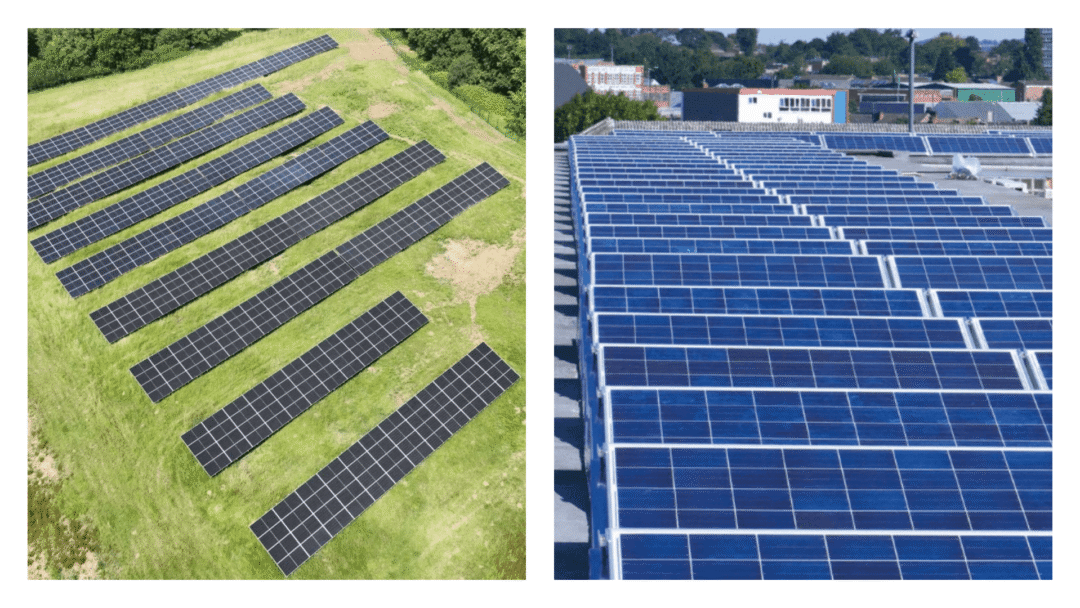
Rooftop solar suits businesses with structurally sound, unshaded roof space and no spare land. It costs less per kWp because there are no groundworks. A ground mounted solar PV system suits businesses with surplus land that need larger capacity, optimal panel orientation and ground level maintenance access, usually at a higher cost per kWp and with a full planning application.
Most UK sites can technically take either. The decision comes down to four things: what your roof can carry, what land you can spare, how much electricity you use during daylight hours, and what your grid connection will allow
Key Takeaways
- Rooftop solar is normally the cheaper option per kWp because it needs no piling, fencing, trenching or access track
- A ground mounted solar PV system typically generates 10 to 20 percent more per kWp because tilt and orientation are not dictated by the building
- Rooftop arrays on commercial buildings often proceed under permitted development rights, while ground mount almost always requires a full planning application
- Roof age, structural loading capacity and remaining lease term are the three most common reasons rooftop is ruled out
- Both options attract the same capital allowances treatment and the same business rates exemption on qualifying onsite generation equipment
- Payback is driven far more by your self-consumption rate than by the mounting method
What Is a Ground Mounted Solar PV System?
A ground mounted solar PV system is a solar array installed on land using a purpose-built frame rather than on a building. The panels sit on steel or aluminium mounting structures anchored by driven piles, screw piles or concrete ballast, depending on ground conditions.

A typical commercial installation includes:
- Foundations, either piled into the ground or ballasted where piling is unsuitable
- A fixed-tilt mounting frame, usually set between 15 and 25 degrees facing south in the UK
- String inverters mounted on the frame, or a central inverter housed in a container
- Buried DC and AC cabling running to the point of connection
- Perimeter deer fencing, CCTV and an access track for maintenance vehicles
Commercial ground mount projects generally start around 250 kWp and scale into the megawatts. EvoEnergy’s ground mount solar systems are designed for exactly this scale, where unproductive land can be converted into generating capacity.
Single-axis tracking systems, which rotate panels to follow the sun, add roughly 15 to 25 percent to annual yield but also add moving parts, maintenance cost and capital expenditure. Fixed-tilt remains the default for UK commercial sites because the added yield rarely justifies the lifetime service burden at this scale.
What Is Commercial Rooftop Solar?
Commercial rooftop solar uses the existing building envelope as the mounting surface. There are two dominant configurations in the UK:
- Pitched metal roofs (trapezoidal or standing seam) take penetrative or clamped fixings, with panels following the existing roof pitch and orientation
- Flat membrane roofs take ballasted east-west arrays, where panels are arranged in opposing rows to spread generation across the day

East-west flat roof arrays produce less per kWp than a south-facing array, but they produce more in the morning and late afternoon. For a business running two shifts, or a cold store with early and late demand peaks, that flatter generation curve often delivers better financial performance than a peakier south-facing profile.
Rooftop systems on large industrial buildings commonly range from 50 kWp to well over 1 MWp. EvoEnergy’s 8.06 MWp installation at Aldi’s Bardon distribution centre shows the upper end of what a single roof can carry. Solar rooftop systems remain the most common starting point for UK businesses because the asset already exists and no land is consumed.
Comparison Between
Rooftop Solar vs Ground Mounted Solar PV System
| Factor |
Commercial Rooftop Solar |
Ground Mounted Solar PV System |
| Typical cost per kWp |
Lower |
Higher, 15 to 30 percent above rooftop |
| Land requirement |
None |
Roughly 2.5 to 4 acres per MWp |
| Annual yield per kWp |
Constrained by roof pitch and aspect |
Optimised tilt and orientation |
| Planning permission |
Often permitted development with prior approval |
Full application almost always required |
| Structural survey |
Required before design |
Not applicable, ground investigation instead |
| Maintenance access |
Working at height, edge protection needed |
Ground level, vehicle accessible |
| Expansion potential |
Capped by available roof area |
Scalable across available land |
| Security requirement |
Minimal |
Fencing, CCTV and monitoring needed |
| Cable run to connection |
Short, low losses |
Longer, trenching and higher losses |
| Typical programme |
4 to 12 weeks on site |
12 to 30 weeks including groundworks |
| Tenure dependency |
Building lease or freehold |
Land lease or freehold |
| Roof lifespan interaction |
Ties array life to roof life |
Independent of building condition |
The single biggest differentiator is not in the table. It is whether the site has genuinely spare land at all. Most urban and industrial estate sites do not, which settles the question before cost enters the discussion.
Ground Mounted Solar PV System Cost vs Rooftop Solar Cost
Quoted price per kWp is the wrong starting point. Both options have cost drivers that swing the final figure by more than the difference between the two technologies.
Rooftop cost drivers
- Roof type and fixing method, with standing seam clamps costing less to install than penetrative fixings on ageing membranes
- Access equipment, mansafe systems and edge protection
- Distance from the array to the incoming supply and the switchroom
- Any structural strengthening identified by the survey
- Asbestos content, which can rule the roof out entirely or trigger a reroof
Ground mount cost drivers
- Ground conditions, established through a geotechnical investigation and pile pull-out testing
- Trenching distance from the array to the point of connection
- Perimeter fencing, CCTV, gates and access track construction
- Ecological mitigation and biodiversity net gain obligations
- Landscape screening required as a planning condition
The variable that outweighs all of these on either option is the grid connection. A DNO connection application under G99 can return a quotation ranging from a few thousand pounds to a six-figure reinforcement cost, depending on local network capacity. Check this early. It has cancelled more commercial solar projects than planning refusal ever has.
Which Delivers Faster Payback, Rooftop or Ground Mount?
Payback is governed by your self-consumption rate, not by where the panels sit. Every kWh you consume on site displaces electricity you would have bought at your full commercial rate, including standing charges and non-commodity costs. Every kWh you export earns a considerably lower rate under an export agreement.
This produces a result that surprises many finance directors. A 400 kWp rooftop array consuming 90 percent of its output on site frequently outperforms a 1 MWp ground mounted solar PV system exporting half its generation, measured on payback period rather than total savings.
The lever that changes this calculation is either adding battery storage to shift surplus generation into evening demand, or structuring the project under a power purchase agreement so that the capital burden sits elsewhere. You can model your own site’s generation profile using EvoEnergy’s solar output calculator.
Planning Permission for a Ground Mounted Solar PV System
This is where the two options diverge most sharply.
Rooftop. Solar equipment on commercial buildings in England generally falls under permitted development rights in Class J, Part 14 of the General Permitted Development Order. The previous 1 MW capacity cap on rooftop installations was removed in December 2023, which opened up permitted development for large industrial roofs. Prior approval is still required from the local planning authority, and the equipment must not protrude more than 200mm from the roof plane or exceed the highest part of the roof excluding the chimney.
Ground mount. A standalone array exceeding 9 square metres requires a full planning application in almost all cases. Determination typically takes 8 to 13 weeks for a minor application, longer where an Environmental Impact Assessment screening opinion is needed. Planning officers will assess:
- Agricultural land classification. Schemes on Best and Most Versatile land (Grades 1, 2 and 3a) face significantly more scrutiny under national planning policy
- Glint and glare. Mandatory assessment near airfields, highways and railway lines
- Landscape and visual impact. Particularly relevant in open countryside or near designated landscapes
- Ecology and biodiversity net gain. Most major developments in England now require a measurable 10 percent biodiversity net gain, which is achievable on solar sites through wildflower seeding and hedgerow planting but must be designed in from the start
- Cumulative impact. Where other solar schemes already exist nearby
Listed buildings, conservation areas and National Landscapes restrict both options. Scotland, Wales and Northern Ireland operate separate planning regimes with different thresholds, so a UK-wide estate needs jurisdiction-specific advice.
How to Choose Between Rooftop and Ground Mount Solar?
Choose Commercial Rooftop Solar If Your Site Has
- A roof with at least 15 to 20 years of remaining life, ideally reroofed or new build
- Confirmed structural capacity for an additional 12 to 20 kg per square metre
- Minimal shading from plant, flues, parapets or neighbouring buildings
- A long remaining lease or freehold ownership of the building
- High daytime electricity demand aligned with generation hours
- No usable spare land, which describes most industrial estate and urban sites
Choose a Ground Mounted Solar PV System If Your Site Has
- Surplus, unproductive land close to the point of consumption
- Electricity demand exceeding what the available roof area can supply
- An ageing roof, planned reroof, or asbestos cement sheeting
- A requirement to maximise generation per kWp installed
- A landlord or freeholder unwilling to permit roof penetrations
- Plans to add EV charging infrastructure or battery storage that will increase site demand
Agricultural businesses sit in an interesting middle position. Farm buildings offer large, simple roof spans, while surrounding land offers ground mount potential. EvoEnergy’s work across farms and agriculture frequently combines both, using rooftop for grain drying and refrigeration loads and ground mount for scale.
What About Solar Carports? The Option Most Businesses Overlook
Businesses comparing rooftop against ground mount often miss a third route. A solar carport is a ground-anchored canopy built over existing parking, which means it consumes no additional land and requires no roof.

Carports carry a higher cost per kWp than either alternative because the structure has to span vehicles and meet loading requirements. In return they deliver optimal orientation, sheltered parking, a natural host structure for EV chargers, and a visible sustainability statement at the front of the site.
For retail, healthcare, education and office sites with large car parks and limited roof space, solar carports frequently outperform both of the options in this comparison. EvoEnergy’s project at Paulton’s Park combined rooftop, carport and battery storage on one site for this reason.
Maintenance and Operational Differences Over 25 Years
Design life is comparable across both options, with panels typically warranted for 25 to 30 years and inverters replaced once during that period. The operational differences are practical rather than technical.
| Maintenance factor |
Rooftop |
Ground Mount |
| Access method |
MEWP, scaffold or mansafe system |
Vehicle access at ground level |
| Panel cleaning |
Higher cost, access dependent |
Lower cost, straightforward |
| Vegetation management |
Not applicable |
Grass cutting or grazing required |
| Soiling risk |
Bird fouling, industrial deposition |
Ground dust, snow accumulation at low tilt |
| Fault response time |
Slower, access arrangements needed |
Faster |
| Security risk |
Low |
Cable and panel theft, mitigation required |
| Roof warranty interaction |
Must be preserved through fixing design |
None |
Ground mount sites carry an ongoing land management obligation that rooftop does not. Sheep grazing is the common solution, and it doubles as a biodiversity and stakeholder story. It does require fencing designed for livestock and a grazing agreement.
Whichever route you take, performance degrades quietly without monitoring. EvoEnergy’s nb aftercare and optimisation services exist because a system running at 85 percent of design output rarely announces itself.
Can You Combine Rooftop and Ground Mounted Solar on One Site?
Yes, and on larger industrial and logistics sites it is increasingly the norm.
Phased deployment usually runs rooftop first, because it delivers the fastest route to generation with the least planning risk, then ground mount later as demand grows or electrification increases load. Both arrays can feed a single point of connection, which simplifies metering and DNO administration, though the connection agreement needs to be sized for the eventual total from the outset.
Applying for a larger connection capacity than you need on day one costs little at application stage and saves a great deal later. Retrofitting additional capacity into a connection agreement is where phased projects tend to stall.
Adding smart grid energy management across a mixed estate lets you balance generation from both arrays against storage and EV charging demand, rather than managing each asset in isolation.
Ready to Find Out Which Option Your Site Supports?
The honest answer to rooftop versus ground mount is that it is a site-specific engineering question, not a preference. It depends on what your roof can carry, what land you can release, how your demand profile sits across the day, and what the local network will accept.
A feasibility assessment answers all four. EvoEnergy’s process covers structural survey or ground investigation, shading analysis, half-hourly consumption profiling, DNO capacity checks, and financial modelling across CAPEX, lease and PPA routes, so the recommendation is grounded in your numbers rather than industry averages.
Book a site feasibility assessment with EvoEnergy and get a costed, evidence-based recommendation for your site.
Prefer to explore first? Compare solar rooftop and ground mount solar in detail, or browse our completed projects to see how comparable businesses decided.
Frequently Asked Questions
How much land does a ground mounted solar PV system need?
As a working figure, allow 2.5 to 4 acres per MWp of installed capacity for a fixed-tilt system in the UK. The range reflects row spacing, tilt angle and the land needed for inverter compounds, access tracks and screening. Sloping or irregular parcels need more.
Is a ground mounted solar PV system more efficient than rooftop solar?
The panels themselves are identical in efficiency. A ground mounted system usually generates 10 to 20 percent more per kWp annually because tilt and orientation are optimised rather than dictated by the roof. Ground level airflow also keeps modules slightly cooler, which marginally improves output.
Do I need planning permission for a ground mounted solar PV system?
In almost all commercial cases, yes. Standalone ground mounted arrays above 9 square metres require a full planning application in England. Rooftop installations on commercial buildings frequently proceed under permitted development rights with prior approval instead.
How long does a ground mounted solar PV system last?
Panels are typically warranted for 25 to 30 years with performance guarantees around 80 to 87 percent of original output at year 25. Mounting structures are specified for a comparable life. Inverters usually need replacement once, around year 12 to 15.
Can a ground mounted solar PV system be installed on agricultural land?
Yes, and thousands of UK schemes are. Planning authorities apply greater scrutiny to Best and Most Versatile land, so lower-grade, marginal or previously developed parcels face fewer objections. Sheep grazing alongside the array is widely accepted and supports the planning case.
Is rooftop solar cheaper than a ground mounted solar PV system?
Per kWp installed, rooftop is usually 15 to 30 percent cheaper because it avoids groundworks, fencing, trenching and access tracks. Ground mount closes some of that gap at larger scale through economies of scale and higher output per kWp.
Which option is better for a business with high daytime energy use?
Whichever one you can size closest to your daytime demand without significant export. High self-consumption is the strongest single driver of return, which often makes a well-sized rooftop system the better financial choice even where land is available.