Shorter days, heavier cloud cover and the prospect of snow can make solar energy seem less dependable during the British winter. For businesses considering solar, or assessing the performance of an existing installation, it is natural to question whether panels can still make a meaningful contribution when sunlight is limited. It’s easy to look outside in the summer and think that solar panels are a great idea, but looking out of your office window in winter might not have quite the same effect. The three-month British winter (which may feel more like a four- or five-month season some years) doesn’t exactly inspire confidence in solar panels’ effectiveness.
The reality is that solar panels continue to generate electricity throughout winter, including on overcast days. Photovoltaic cells respond to daylight rather than heat alone, and cooler conditions can support panel efficiency. However, reduced daylight hours, a lower sun position and snow coverage can all lower total seasonal output compared with the brighter summer months.
But does this need to be the case? Do solar panels work as well in winter as in summer?
Yes, they still work in winter but will only produce around a fifth of the energy which they produce in the summer. A well-designed commercial system accounts for seasonal variation across the full year, while battery storage can help businesses make better use of electricity generated during available daylight.
How Do Solar Panels Make Energy?
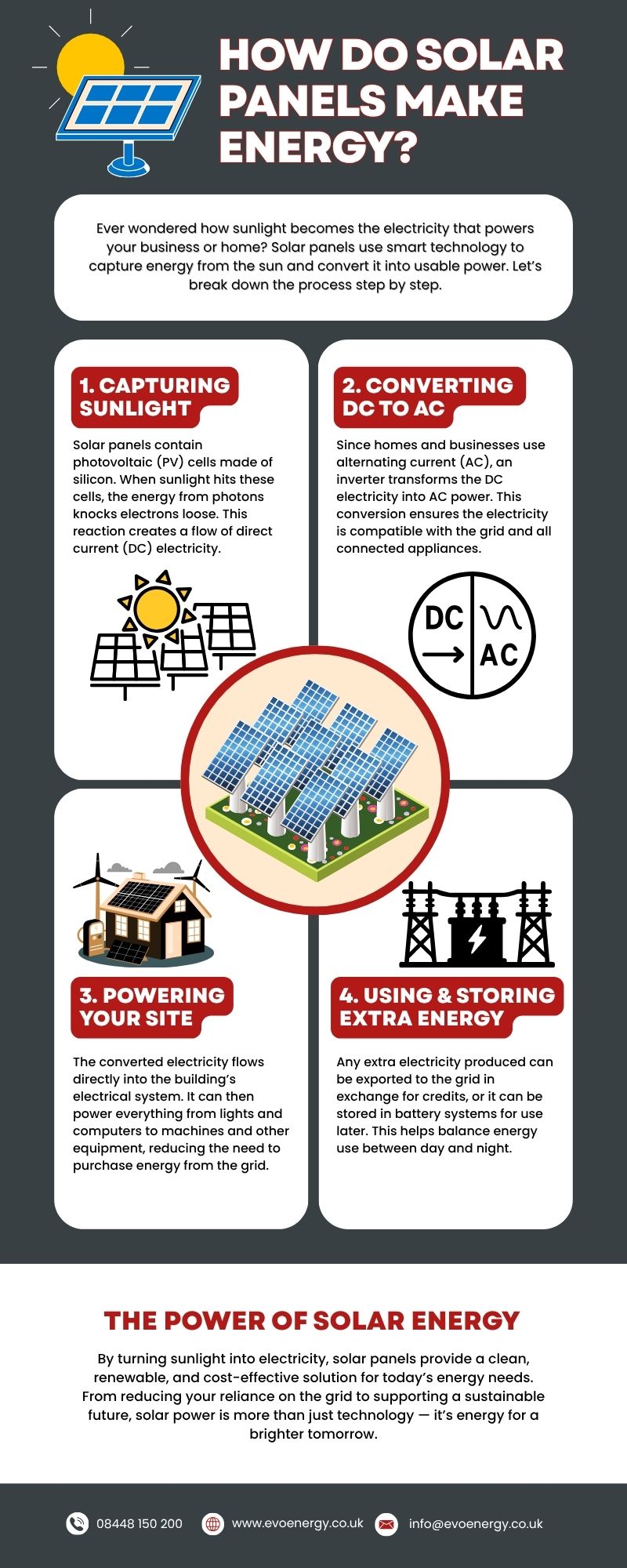
Solar panels convert sunlight into electricity using photovoltaic (PV) cells. The panels generate direct current (DC) power, which an inverter converts into alternating current (AC) for use across your business premises. This can reduce reliance on grid electricity, while surplus generation may be stored in a battery or exported to the grid, supporting lower energy costs and stronger operational resilience.
Before going into specifics, it is important to understand how solar panels work. The core ingredients are photovoltaic cells: special units normally made out of a kind of silicon. Photovoltaic cells, sometimes called solar cells have a property that means they produce energy when hit by photons, which is the name for light waves/particles. This energy is then turned into a usable electric current by an inverter and fed into our offices, homes or the national grid.
Importantly, it is photons on the visible spectrum (i.e. light that we can see, not infra-red or ultraviolet light) that energise photovoltaic cells, not direct sunlight specifically. There are always photons flying towards a solar panel, regardless of whether or not the sun is shining on it directly.
Direct sunlight is a better source of power because it is stronger, but solar energy production does not simply stop on an overcast day. We’ll return to this idea shortly.
Learn more about how solar panels work.
How Does The Winter Affect Solar Panels’ Energy Production?
Solar panels do not perform identically in summer and winter. We’ve broken down the three main factors below.
Temperature
Contrary to popular belief, colder weather is actually better for solar panels’ efficiency than warmer weather – this is a slight benefit from the winter months. While this might seem counterintuitive, remember that only visible light matters for energy production; heat (infra-red light waves) does not interact with photovoltaic cells to make more energy.
Light levels
Unfortunately, any benefit from colder temperatures is outweighed by lower light levels and so they won’t work as well on a cloudy day. Three factors contribute to less light in winter:
- A higher proportion of overcast days.
- Fewer hours of daylight.
- The sun is lower in the sky.
While solar panels can still generate energy on overcast days, they could be anywhere between 50% and 90% less efficient. In addition, the sun being lower in the sky means that less direct sunlight hits your solar panels and shorter days mean that sun simply isn’t around for as long in a 24-hour period.
Snow
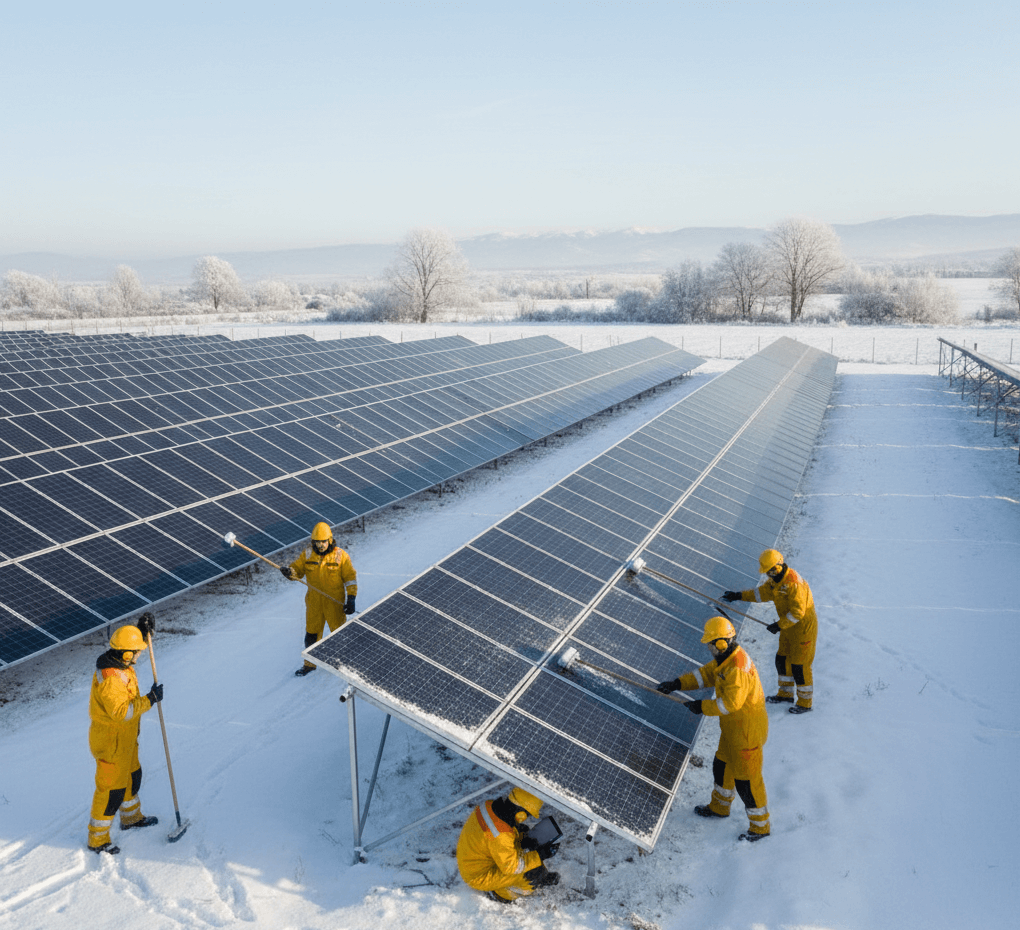
Snow is the biggest issue in winter, though thankfully it is the one that you can do something about. Any cells covered by snow will not generate any energy, as sunlight cannot reach them. The simplest solution is to get up on the roof (when it is safe to do so) and clear the panels so that they are no longer obstructed.
How Much Do Solar Panels Generate in Winter?
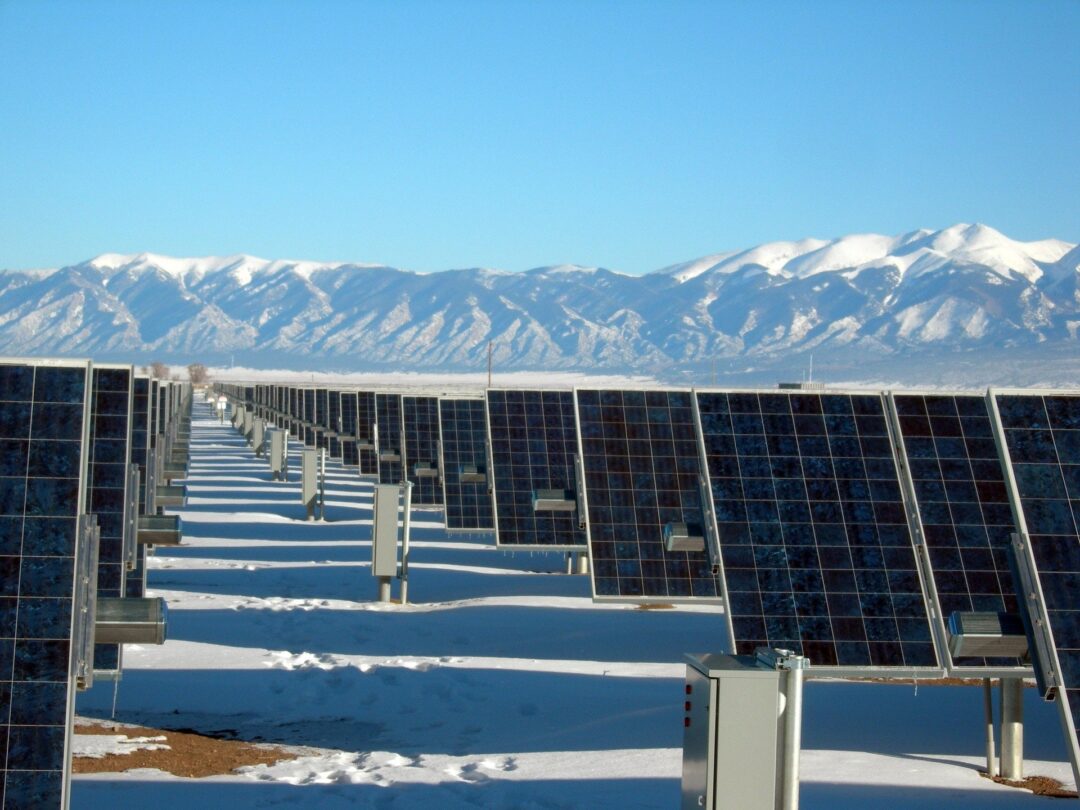
Solar panels continue to generate electricity throughout winter, although output is typically lower than during summer due to shorter daylight hours, lower sun angles, and more frequent cloud cover. As a general guide, winter generation may be around one-fifth of summer output, with actual performance depending on your system’s size, orientation, shading, location, and weather conditions.
For commercial businesses, winter performance should be considered as part of the full annual energy picture. A well-designed solar PV system can still contribute to lower electricity costs by reducing the amount of power purchased from the grid. Pairing solar with battery storage can also help your business retain and use available generation more strategically, while supporting greater energy resilience when demand is high or grid prices are volatile.
Keep Your Business Powered Through Every Season
Winter brings lower light levels and shorter days, but commercial solar panels can still generate valuable electricity throughout the season. With a system designed around your site’s annual energy profile, and supported by battery storage where appropriate, your business can reduce grid reliance, control energy costs, and strengthen long-term energy resilience.
Every commercial site has different energy demands, roof space, and operational priorities. EvoEnergy can assess your property and develop a solar PV and battery storage solution built to deliver value across every season.
Ready to explore solar for your business? Contact EvoEnergy today to arrange a commercial solar consultation.