Key Takeaways
- A commercial solar power installation starts with energy data, not panel selection. A credible installer will usually review 12 to 24 months of half-hourly electricity data to understand consumption, peak demand, operating hours, tariffs, and future load growth before recommending a system size.
- The site survey determines whether the proposed solar PV system is practical and financially viable. For rooftop solar, the installer checks roof age, condition, material, load-bearing capacity, available space, obstructions, and shading, while ground-mounted systems require land, soil, topography, and cable route assessments.
- Commercial solar design must account for panels, inverters, layout, cabling, switchgear, and HV/LV infrastructure. Older industrial sites may need electrical upgrades before solar can be safely connected to the main distribution board or switchgear.
- DNO approval is often one of the most important timeline factors in a commercial solar project. Smaller systems may follow the G98 notification route, but most larger commercial solar installations require a G99 application, which can involve a network impact assessment and may take several weeks.
- The physical installation is only one part of the full commercial solar power installation timeline. On-site installation may take 3 to 7 working days for a 30 to 100 kWp system, 1 to 2 weeks for 100 to 250 kWp, and 3 to 6 weeks or more for systems above 500 kWp, excluding approvals and procurement.
A commercial solar power installation is one of the most meaningful infrastructure investments a business can make. Done well, it delivers decades of reduced energy costs, a measurable cut in carbon emissions, and a degree of protection against the volatility of the wholesale electricity market. But the process itself involves more steps, more stakeholders, and more technical complexity than most people anticipate before they start.
This guide walks through each stage of a commercial solar installation project in plain terms, so you know what is coming, how long each phase takes, and what decisions you will need to be involved in along the way. Whether you operate a warehouse, a manufacturing facility, a school, or a commercial office, the core process follows the same structure.
TL;DR
A commercial solar power installation is a structured project that moves from energy assessment and site survey through to system design, approvals, procurement, installation, commissioning, and long-term monitoring. For UK businesses, the most successful projects are planned around site energy use, roof or land suitability, DNO approval, electrical infrastructure, safety requirements, and future energy needs such as battery storage or EV charging.
What Is a Commercial Solar Power Installation?
A commercial solar power installation is the design, procurement, and deployment of a photovoltaic (PV) energy system on a business or institutional property. Unlike domestic solar, commercial systems are larger in scale, typically starting from around 30 kilowatt-peak (kWp) and often extending to hundreds of kilowatts or beyond for industrial sites.
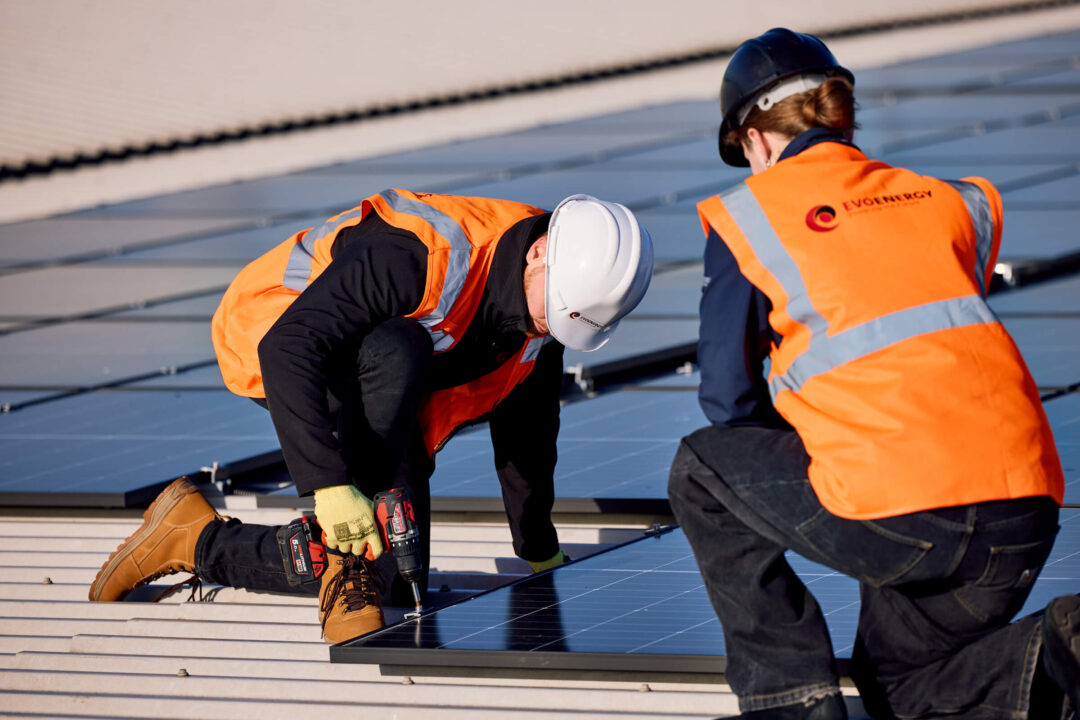
The systems can take several forms depending on the site. Rooftop solar is the most common configuration, converting unused roof space into a source of on-site renewable generation. Ground-mounted solar suits sites with available land and high energy demand, while solar carports offer a dual-purpose solution that provides covered parking and clean power simultaneously.
Commercial solar installations serve a wide range of sectors. At EvoEnergy, we work with organisations in manufacturing, cold storage and logistics, agriculture, education, aerospace, offices, and the public sector, and each of those environments brings its own set of priorities, constraints, and opportunities.
The installation itself is the visible result of a process that spans several months, involves multiple professional disciplines, and requires careful coordination between the installer, the client, the Distribution Network Operator (DNO), and local planning authorities. Understanding the full arc of that process is the best preparation any business can have.
Phase 1: Initial Consultation and Energy Assessment for Commercial Solar
Every credible commercial solar installation begins with a thorough understanding of how your business uses energy. Before any system is sized or proposed, a competent installer will ask for your electricity consumption data, typically 12 to 24 months of half-hourly interval data from your utility or smart meter. This is the raw material that determines whether solar is the right fit, and if so, how large the system should be.
What Happens During the Energy Assessment?
The energy assessment looks at several things in parallel:
- Your total annual electricity consumption in kilowatt-hours (kWh)
- Your peak demand periods and the times of day your usage is highest
- How well your operational hours align with daylight generation hours (a business running primarily during daylight has the most to gain from solar self-consumption)
- Your current electricity unit rate and standing charges
- Any plans for future energy demand growth, such as electric vehicle fleet charging or new machinery
The output of this stage is not just a recommendation for system size. It is a realistic picture of what solar can and cannot do for your particular operation. For some sites, solar alone is the right solution. For others, the data points to a hybrid approach that combines solar with battery energy storage or smart grid technology to capture more value.
Site Survey and Structural Assessment

Alongside the energy assessment, the installation team will visit the site to carry out a physical survey. For rooftop systems, this includes assessing the roof’s age, condition, material type, load-bearing capacity, and available area free from obstructions such as plant equipment or skylights. For ground-mounted systems, the survey looks at land topography, soil conditions, and cable route distances to the main electrical connection point.
Shading analysis is also conducted at this stage, often using specialist software and drone surveys or LiDAR data to model how shadows from neighbouring buildings, trees, or roof features will affect output across different times of year. Shading that looks minor to the naked eye can have a significant effect on energy yield if it falls across key parts of the array.
Phase 2: System Design and Engineering
Once the energy assessment and site survey are complete, the engineering team moves into detailed system design. This is where the shape, layout, and technical specification of your commercial solar installation take form.
Panel Selection and Array Layout
The design process begins with selecting the right panel technology and determining how to arrange the array for maximum output within the available space. The main panel types used in commercial applications are:
| Panel Type |
Typical Efficiency |
Best Application |
| Monocrystalline |
20–23% |
Space-constrained rooftops, high-value sites |
| Polycrystalline |
15–18% |
Cost-sensitive large arrays with ample space |
| Bifacial Monocrystalline |
21–24% (with rear gain) |
Ground mounts, carports, flat roofs with light-coloured surfaces |
The array layout is developed using specialist PV design software that models panel placement, cable runs, and expected energy yield based on the site’s precise location, orientation, and tilt angle. For complex rooftops or split sites, this design stage may involve several iterations.
Inverter Selection
The inverter converts the direct current (DC) electricity generated by the panels into the alternating current (AC) that the building’s electrical systems can use. The choice of inverter architecture matters for both performance and long-term serviceability:
- String inverters are cost-effective for large, uniform arrays with minimal shading. Each string of panels connects to a central inverter.
- Microinverters attach to each individual panel and are well suited to rooftops with complex shapes or partial shading, since underperforming panels do not drag down the rest of the array.
- Power optimisers paired with a string inverter offer a middle ground, providing panel-level performance management without the higher cost of full microinverter systems.
Electrical Infrastructure Review
A commercial solar system connects into your existing electrical infrastructure at the main distribution board or switchgear. The design phase will flag whether any HV/LV electrical upgrades are required before installation can proceed. This is particularly common on older industrial sites where the switchgear is not rated for the additional generation capacity the solar system will introduce.
Phase 3: Planning Permission and DNO Approval for Commercial Solar Projects
This phase is often the one that surprises business owners the most, not because it is especially complicated, but because of how much it can affect the project timeline. Getting approvals right, and in the right sequence, is one of the clearest differences between an experienced commercial installer and one who is learning on the job.
Planning Permission
Many commercial rooftop solar installations fall under permitted development rights in England and Wales, meaning no formal planning application is required. However, there are important exceptions. Planning permission is typically needed if:
- The installation is on a listed building or within a conservation area
- The system is ground-mounted rather than roof-mounted
- The panels would protrude more than 200mm beyond the roofline
- The local planning authority has removed permitted development rights in a specific area
For large ground-mounted or carport systems, a full planning application is often required, and for very large-scale projects, an environmental impact assessment may also be needed. A competent installer will advise on this from the outset and manage the application process on your behalf.
DNO Application and Grid Connection
Every commercial solar system that connects to the grid requires approval from the relevant Distribution Network Operator. The DNO needs to confirm that the local network has sufficient capacity to accept the generation from your system without causing stability issues for other users.
For smaller systems, the process follows a notification-based route under Engineering Recommendation G98. Larger commercial systems typically require a full G99 application, which involves a network impact assessment. According to the Energy Networks Association, G99 approvals can take anywhere from four to twelve weeks depending on the complexity of the connection and the DNO’s current workload.
The good news is that for most commercial rooftop installations, this process runs in parallel with detailed engineering design, so it does not necessarily add twelve weeks to your overall project timeline. A well-managed project keeps these workstreams moving simultaneously.
Phase 4: Procurement and Equipment Lead Times
Once planning and DNO approvals are secured, the project moves into procurement. This is when the solar panels, inverters, mounting systems, cabling, and associated electrical equipment are ordered.
Lead times vary depending on the size of the system and the current demand on suppliers, but for most commercial installations, equipment delivery falls within a two to six week window from order placement. Larger or more complex systems using specialist components may take longer.
Several things are worth verifying during this phase:
- That all panels and inverters carry current MCS (Microgeneration Certification Scheme) product certification, which is a prerequisite for grid connection and Smart Export Guarantee eligibility
- That the warranty terms are clearly documented: most quality commercial panels carry a 25-year linear performance warranty guaranteeing a minimum output level, while inverter product warranties typically run from 10 to 15 years
- That the racking and mounting system is rated for the wind and snow load conditions of your specific location and roof type
- That a Risk Assessment and Method Statement (RAMS) has been prepared for the installation phase, covering working at height, electrical isolation procedures, and emergency protocols
Phase 5: The Physical Commercial Solar Installation Process
With approvals in place and equipment on order, the physical work can begin. For most businesses, this is the part of the process they are most visible to, and for most sites, it causes considerably less disruption than people expect.
Site Preparation and Access
Before panels go up, the site needs to be prepared for safe working at height. For rooftop installations this typically means erecting scaffolding or deploying mobile elevated work platforms, depending on the roof configuration. Cable routes are planned and conduit is installed through the building from the roof down to the main electrical panel. If any switchgear upgrades are required, those tend to be completed at this stage too.
Mounting and Racking Installation
The racking system is the structural backbone of the solar array. For pitched roofs, brackets are fixed to the rafters through the roof covering, with waterproofed penetration points to prevent any ingress. For flat roofs, a ballasted or mechanically attached racking system is used, depending on the roof structure and wind load requirements. Ground-mounted systems use driven or screw pile foundations, or in some cases concrete footings for larger arrays.
Panel and Inverter Installation
Once the racking is secure, panels are lifted into position and mechanically fixed to the rails. DC wiring is then run between panels, connecting them into strings that feed back to the inverter location. The inverters are mounted in a weatherproof enclosure, and AC wiring connects through the isolators and protection devices to the main distribution board. The monitoring system, which allows real-time visibility of generation and system performance, is configured at this stage.
How Long Does the Physical Installation Take?
| System Size |
Estimated Physical Installation Time |
| 30–100 kWp |
3–7 working days |
| 100–250 kWp |
1–2 weeks |
| 250–500 kWp |
2–3 weeks |
| 500 kWp and above |
3–6 weeks or more |
These figures cover the on-site installation work only and do not include the permitting, DNO approval, or procurement phases that precede them.
Phase 6: Inspection, Testing, and Commissioning Your Commercial Solar System
A commercial solar installation is not finished when the last panel goes on the roof. Before the system can generate electricity and be connected to the grid, it must pass a series of inspections and tests, and receive formal Permission to Operate (PTO) from the DNO.
Electrical Testing and Safety Checks
The installation team carries out thorough electrical testing before the system is energised. This includes:
- Insulation resistance testing on all DC cabling
- Open-circuit voltage and short-circuit current measurements at string level to verify panel performance
- Earth continuity testing across the entire array
- Verification of all protection devices, isolators, and surge arrestors
- Confirmation that AC output voltage and frequency fall within the parameters specified by the DNO connection agreement
Local Authority and Building Control Inspection
Depending on the scope of the installation and whether building regulations approval was required, a building control officer may need to sign off on the structural aspects of the racking installation and the electrical installation certificate. Your installer should manage this notification and inspection process on your behalf.
DNO Final Meter Installation and Permission to Operate
Once the DNO has received confirmation that the installation has been completed in accordance with their approved connection design, a bi-directional meter is installed. This meter records both the electricity drawn from the grid and any surplus solar electricity exported to it. The DNO then issues formal Permission to Operate, which is the official authorisation for the system to begin generating. Only at this point does your commercial solar installation go live.
Phase 7: Monitoring, Maintenance, and Long-Term System Optimisation
A well-installed commercial solar system requires relatively little ongoing intervention, but it is not a completely set-and-forget asset. Regular monitoring and periodic maintenance are what separate systems that perform to their original yield projections throughout their operational life from those that quietly degrade or encounter faults that go undetected.
Real-Time Monitoring for Commercial Solar Installations
Modern commercial solar systems come with cloud-based monitoring platforms that provide continuous visibility of generation performance. At a minimum, these platforms track daily, monthly, and annual energy output and compare actual performance against the modelled yield for the system. More sophisticated monitoring includes string-level data that can identify if a specific section of the array is underperforming, inverter health metrics, and alert functions that notify the operations team or the installer if a fault is detected.
EvoEnergy’s aftercare service includes ongoing system monitoring alongside planned maintenance visits, ensuring that any performance issues are identified and resolved before they represent a meaningful loss of energy or revenue.
Routine Maintenance Requirements
| Maintenance Activity |
Recommended Frequency |
| Panel visual inspection and cleaning |
1–2 times per year (more frequently in dusty or urban environments) |
| Electrical inspection and thermal imaging scan |
Annually |
| Inverter performance check |
Annually |
| Mounting and racking torque check |
Every 2–3 years |
| Vegetation management (ground mounts) |
As required, typically twice annually |
Panel soiling from dust, pollution, bird fouling, and organic matter is one of the most common causes of below-expected performance in operating commercial solar systems. Research suggests that dirty panels can lose between 5% and 25% of their output depending on the degree of soiling and the climate, making a consistent cleaning schedule genuinely worthwhile from a financial standpoint.
System Optimisation Over Time
A commercial site evolves. Energy demand changes, new equipment is installed, and the economics of battery storage or EV charging infrastructure may shift in ways that make them worth adding to an existing solar installation. EvoEnergy’s optimisation service is designed to revisit the energy strategy at regular intervals, identifying whether the original system design still represents the best available configuration or whether modifications could improve financial returns.
Common Challenges During Commercial Solar Installation (and How They Are Managed)
Experienced commercial solar installers encounter recurring challenges that can affect timelines or budgets if they are not anticipated and planned for. Here is how the most common ones are typically handled.
| Challenge |
What Causes It |
How It Is Managed |
| Roof condition requiring repair or replacement before installation |
Ageing roof surface or structural deterioration found during survey |
Solar project is paused; roof replacement is co-ordinated first, sometimes with the racking designed around new roof specification |
| DNO grid capacity constraints |
Local network at or near capacity, requiring reinforcement before connection is approved |
Installer works with DNO on connection design alternatives; storage and export limiting may be used to reduce grid impact |
| Structural deficiencies identified mid-installation |
Rafter spacing, condition, or load rating not as expected |
Structural engineer engaged; alternative fixing methods or additional supports specified |
| Switchgear or distribution board requiring upgrade |
Existing electrical infrastructure not rated for additional generation |
HV/LV infrastructure upgrade scoped and delivered as part of the project |
| Equipment supply delays |
Supplier lead times longer than projected, particularly for specialist inverters or custom racking |
Alternative certified equipment sourced; project schedule adjusted to minimise impact |
| Planning authority requirements in sensitive areas |
Listed buildings, conservation areas, or nationally designated landscapes |
Planning consultant engaged; design modified to meet heritage or landscape conditions |
How Commercial Solar Supports Your Net Zero and ESG Goals?
For many organisations, the financial case for commercial solar is compelling enough on its own. But the strategic dimension of a solar installation extends beyond energy cost savings. A well-documented renewable energy deployment is a concrete and verifiable contribution to a corporate net zero target, one that sits clearly within Scope 2 of the GHG Protocol framework and can be supported with actual generation data rather than offset credits.
For organisations in sectors where supply chain decarbonisation is increasingly scrutinised by customers and procurement teams, being able to demonstrate on-site renewable generation is becoming a commercial differentiator as much as an ethical one. Find out more about how EvoEnergy supports organisations on their net zero journey, including carbon footprint reduction planning and ESG reporting support.
Your Commercial Solar Power Installation Journey Starts Here
A commercial solar power installation is a structured process that runs across several months and involves a wider range of technical, regulatory, and logistical considerations than most businesses anticipate at the outset.
Understanding the journey from initial energy assessment through to commissioning and long-term monitoring puts you in a far stronger position as a client, helps you set realistic expectations internally, and makes it easier to evaluate the quality of proposals you receive.
For organisations that approach it thoughtfully, commercial solar delivers genuine financial returns, a meaningful contribution to decarbonisation targets, and a degree of energy independence that is increasingly valuable in a market where grid electricity prices remain volatile.
If you are considering a commercial solar installation and want to understand what the process would look like for your specific site, contact EvoEnergy for a free initial consultation and energy assessment.
Frequently Asked Questions
How long does a commercial solar power installation take from start to finish?
The total project timeline for a commercial solar installation typically ranges from three to nine months, depending on system size, planning requirements, and the DNO connection process. The full commercial solar installation process typically takes 2 to 4 months from contract to commissioning for straightforward projects, but more complex or large-scale systems involving ground mounts, planning applications, or significant grid upgrades can take longer. Physical installation usually accounts for only one to three weeks of that overall timeline.
Does commercial solar installation disrupt business operations?
Most of the physical work for a commercial solar installation takes place on the roof, so it is unlikely to disrupt day-to-day operations. A temporary power outage will be required to connect the system to the mains distribution board, but in larger buildings, this is usually isolated to specific areas. With proper planning, these outages can typically be scheduled for periods of minimal operational impact, such as weekends or planned maintenance shutdowns.
Do I need planning permission for a commercial solar installation?
Rooftop solar PV systems generally fall under permitted development and therefore do not need planning permission. However, if you are planning a ground-mounted system, or if your installation is in a conservation area, you may need planning permission. Your installer should clarify this during the initial consultation stage.
What is the difference between G98 and G99 for commercial solar connections?
Systems up to 3.68kW per phase typically fall under G98 regulations, requiring only notification to the DNO. Larger systems require G99 approval, which involves a more detailed application process. Most commercial solar installations will require a G99 application, and the assessment that accompanies it can take between four and twelve weeks.
Can I add battery storage to an existing commercial solar installation?
Yes. Battery storage systems can be retrofitted to most existing commercial solar installations, provided the inverter architecture is compatible or the inverter is replaced. Battery storage increases the proportion of solar energy your site self-consumes, reduces exposure to demand charges, and can provide backup power for critical loads in the event of a grid outage.
What maintenance does a commercial solar system require?
Commercial solar systems require minimal but consistent maintenance. Annual electrical inspections, regular panel cleaning one to twice per year depending on the site environment, and periodic checks on mounting hardware are the standard requirements. Most reputable installers offer structured maintenance agreements that cover these activities and provide priority response to any faults or underperformance alerts.
About the Author
Paul Lukehurst is a Principal Design Engineer at EvoEnergy, with over 10 years' experience in the renewable energy sector across engineering and leadership roles. His expertise spans the full project lifecycle — from feasibility and financial modelling through to detailed design, procurement, and delivery oversight — ensuring systems are technically sound, buildable, and maintainable.
Solar PV Design
Battery Storage
Grid Connection
EV Charging
Net Zero