As more commercial solar installations across the UK approach the end of their operational life, decommissioning is becoming an increasingly important part of responsible asset management. While solar energy is rightly associated with sustainability, removing an ageing or underperforming system is not as simple as taking panels off a roof. It requires careful planning, technical expertise, and full consideration of environmental, structural, and regulatory risks.
Professional solar decommissioning helps businesses protect their site, meet compliance obligations, and ensure materials are handled, recycled, or disposed of responsibly. For organisations focused on safety, reputation, and long-term sustainability, it is a critical step that should never be overlooked.
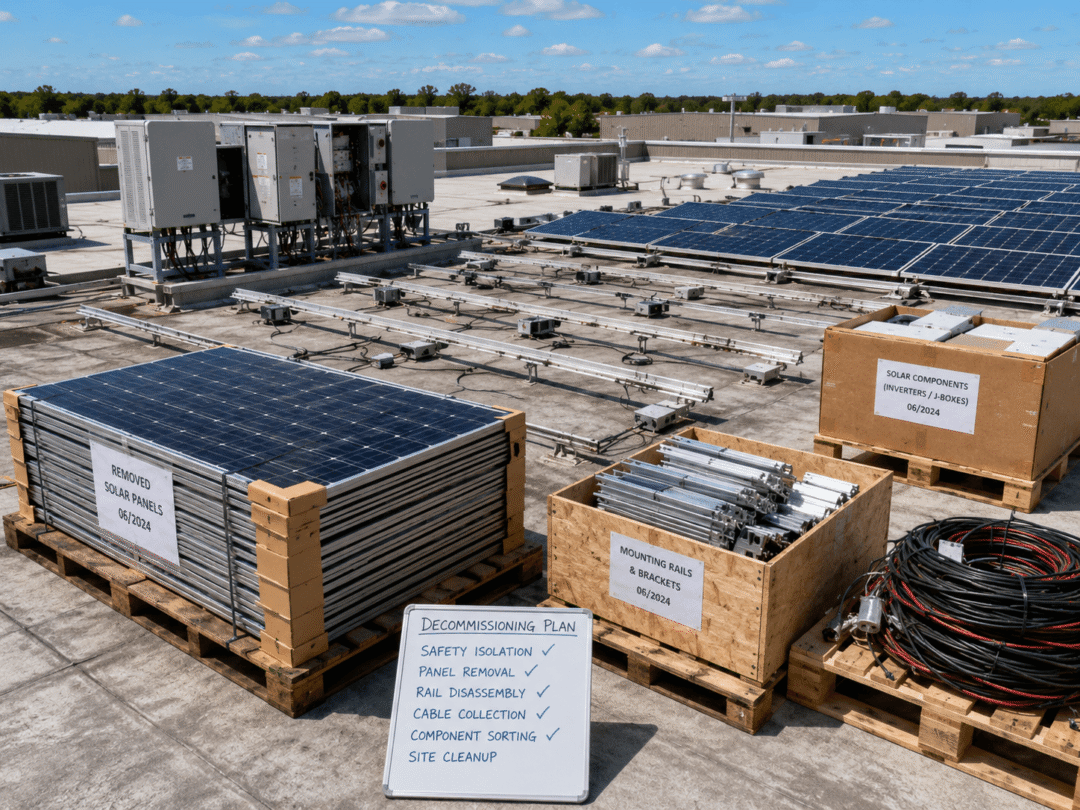
What is solar panel decommissioning, and when is it needed?
Decommissioning means shutting down and removing a solar power system, then dealing responsibly with the equipment and the site afterwards. It applies equally to a commercial rooftop array and a multi-hectare solar farm. The principles are the same; the logistics, scale, and access challenges differ.
There are four common triggers:
- End of operational life. Panels degrade slowly over decades, and eventually the output no longer justifies keeping the system in place.
- Repowering. Older, lower-output panels are removed and replaced with modern, higher-efficiency modules, often on the same mounting and grid connection. You can read more about how this works on EvoEnergy’s optimisation and repowering service.
- Change of land use or sale. A site may be sold, redeveloped, or returned to agricultural use.
- Damage write-off. Storm, fire, or flood damage can render a system beyond economic repair.
Panels themselves can last a long time, with many modern modules rated for 25 to 30 years and some continuing beyond that. The point of decommissioning is to manage what happens once that working life ends, rather than leaving redundant electrical equipment in place.
Why does professional solar panel decommissioning matter?
This is the heart of the matter. A solar array is a live electrical installation containing heavy, fragile materials, some of which are hazardous. Handling that safely is a specialist job, and there are four clear reasons it should be done professionally.
It protects people and the site from electrical and physical hazards
A solar system generates direct current whenever light hits the panels, so it cannot simply be switched off and forgotten. Safe de-energising and electrical isolation is the first and most critical step, and it carries genuine risk of electric shock and arc flash if done incorrectly. Panels and mounting structures are also heavy and awkward, frequently positioned on roofs or across large open sites, which introduces working-at-height and manual-handling hazards. The UK’s Health and Safety Executive sets out clear duties around both electrical work and working at height, and a competent contractor builds compliance with these into the method statement from the start.
It protects the environment from contamination
Solar panels and their associated equipment can contain materials that are harmful if released. When panels are broken carelessly or dumped, substances such as lead and cadmium can leach into soil and groundwater. Professional decommissioning keeps these materials contained, segregates hazardous components, and routes everything to the correct treatment facility, which is the single biggest factor in protecting the local environment.
It keeps you compliant and audit-ready
Solar waste sits within a defined regulatory framework, covered in detail below. Using a licensed carrier, an authorised treatment facility, and keeping the right documentation protects you from fines, failed environmental audits, and breaches of your legal duty of care. For organisations reporting against sustainability commitments, that paper trail also feeds directly into ESG reporting.
It recovers value and supports the circular economy
Controlled dismantling allows the recovery of valuable materials such as glass, aluminium, silicon, silver, and copper, and lets still-functional panels be reused or refurbished. That reduces waste, lowers demand for virgin raw materials, and turns an end-of-life liability into a source of recoverable value.
The risks of improper or DIY solar decommissioning
It is worth being direct about what goes wrong when decommissioning is rushed, handed to an unqualified contractor, or treated as ordinary demolition. The failure modes are predictable:
- Electrical injury caused by attempting removal before the system is properly isolated.
- Environmental contamination from panels that are smashed on site or sent to landfill.
- Duty of care breaches, fines, and failed audits where waste is not handled by licensed parties.
- Land left unrestored or contaminated, which damages resale and reuse value.
- Reputational and ESG damage, particularly for organisations that have publicly committed to sustainability targets.
Cutting corners almost always costs more in the end than doing the work properly the first time.

The professional solar panel decommissioning process, step by step
A well-run decommissioning project follows a clear sequence. The table below summarises the stages and what each one protects, then the detail follows.
| Stage |
What happens |
What it protects |
| 1. Planning and documentation |
Review the decommissioning plan, confirm responsibilities and permits |
Compliance, clear accountability |
| 2. Site and hazard assessment |
Survey condition, identify hazardous components, plan safe access |
People, site, environment |
| 3. Safe de-energising and isolation |
Shut down and electrically isolate the system |
People and site safety |
| 4. Dismantling |
Remove panels, inverters, cabling, transformers, mounting |
Site integrity, clean handling |
| 5. Waste segregation |
Separate recyclable and hazardous streams |
Environment, material recovery |
| 6. Compliant transport and treatment |
Licensed carrier to an authorised treatment facility |
Legal compliance |
| 7. Site restoration |
Return the land to its agreed condition |
Land value, future reuse |
| 8. Records and certification |
Complete the audit trail and waste documentation |
Audit readiness, peace of mind |
Hazardous components to handle with care during decommissioning
One of the clearest reasons decommissioning is a specialist job is the presence of hazardous materials in and around a solar installation. These are classified as hazardous waste and carry stricter handling and documentation rules.
| Component |
Why it needs special handling |
| Cadmium-containing thin-film panels |
Cadmium is toxic and must be contained and treated correctly |
| Transformer oils |
Can contaminate soil and water if spilled |
SF6 gas
(in some switchgear) |
A potent greenhouse gas that must be captured, not vented |
Lithium-ion batteries
(where storage is present) |
Fire risk and chemical hazard; require specialist handling |
Lead
(in certain panel and solder types) |
Harmful if released into the environment |
If your site combines solar with battery storage or significant HV/LV electrical infrastructure, the hazardous-handling requirements are greater still, which is another reason to use a contractor experienced across all of these technologies.
The UK regulations behind solar panel decommissioning
Decommissioning a solar installation in the UK sits within several overlapping regulatory frameworks. Understanding them upfront helps you avoid fines, delays, and failed audits.
- WEEE classification. Solar panels are Waste Electrical and Electronic Equipment under Category 14 of the WEEE Regulations 2013, so they must go to an authorised treatment facility rather than landfill or mixed waste. The framework is explained on the UK government’s WEEE guidance pages.
- Treatment at an AATF. Panels must be processed at an Environment Agency-regulated Authorised Approved Treatment Facility, with documentation to prove it. The relevant regulator differs by nation: the Environment Agency in England, SEPA in Scotland, and Natural Resources Wales in Wales.
- Producer compliance schemes. UK manufacturers and importers must participate in a producer compliance scheme, which underpins the take-back and recycling routes for out-of-service panels.
- Planning conditions. Planning authorities often require a decommissioning and site-restoration plan as part of the original consent, particularly for ground-mounted solar farms.
- Duty of care and health and safety. The waste duty of care, hazardous waste regulations, and occupational health and safety standards all apply throughout.
Because guidance in this area continues to evolve, it is worth confirming the current position with the relevant regulator before a project begins. Our consultancy team can help interpret how these requirements apply to a specific site.
Who is responsible for decommissioning a solar site?
Responsibility is one of the most common points of confusion, and getting it clear early saves a great deal of friction later.
- Asset owners generally hold the duty of care for the waste once a system is removed, even where a producer is involved in take-back.
- Producers (manufacturers and importers) carry obligations under WEEE rules and often provide collection or recycling routes.
- Under a Power Purchase Agreement, the system owner, which is usually the PPA provider rather than the host site, typically holds end-of-life responsibility. This should be stated explicitly in the contract, so it is worth checking the wording rather than assuming.
If you are unsure where responsibility sits for your site, that is exactly the kind of question to resolve at the planning stage rather than at removal.
How professional decommissioning protects and restores your site?
Bringing the threads together, a professionally managed decommissioning project protects your site in four concrete ways. Controlled removal protects roofs, ground, and surrounding structures from accidental damage.
Containment of hazardous streams protects soil and groundwater. Land restoration returns the site to productive use, whether that is agricultural land, a commercial yard, or a development plot, preserving or recovering its value. And complete documentation gives you clean evidence of responsible closure, which matters for audits, property sales, and lease handbacks.
For ground-mounted sites in particular, restoration is often the difference between land that can return straight to use and land that needs remediation. EvoEnergy’s experience across ground-mount solar and large rooftop arrays means restoration is planned from the outset, not treated as an afterthought.
How decommissioning fits into the wider solar lifecycle?
Decommissioning is best understood as one stage in a longer lifecycle rather than an isolated event. The strongest outcomes come from thinking about end-of-life at the point of installation, when the decommissioning plan, the choice of mounting, and the contract terms can all be set up to make removal straightforward two or three decades later.
It also connects closely to two adjacent decisions. The first is repowering, where decommissioning old panels and installing new ones happens as a single coordinated project, minimising downtime and reusing infrastructure where possible. The second is ongoing maintenance, because a well-maintained system reaches its planned end-of-life in predictable condition rather than failing unexpectedly.
Plan Your End-of-Life Strategy Before It Becomes Urgent
Solar panel decommissioning is far more than tearing down old equipment. Done properly, it protects your people from electrical and physical hazards, shields the surrounding soil and water from contamination, keeps you firmly on the right side of UK regulations, and recovers real value through recycling and land restoration. The organisations that handle it best are the ones that plan for it early, ideally at the point of installation, and partner with a contractor experienced across the full solar lifecycle.
EvoEnergy provides a complete turnkey service spanning consultancy, installation, aftercare, and optimisation, with decommissioning, refurbishment, and repowering built into its long-term aftercare services. Whether you are planning to repower an ageing array, restore a site for reuse, or simply want a clear end-of-life strategy in place, our engineers can help you map the safest and most cost-effective route.
Make an enquiry today to speak with our team about your site, or explore the full range of services that support your journey to net zero.