Summary
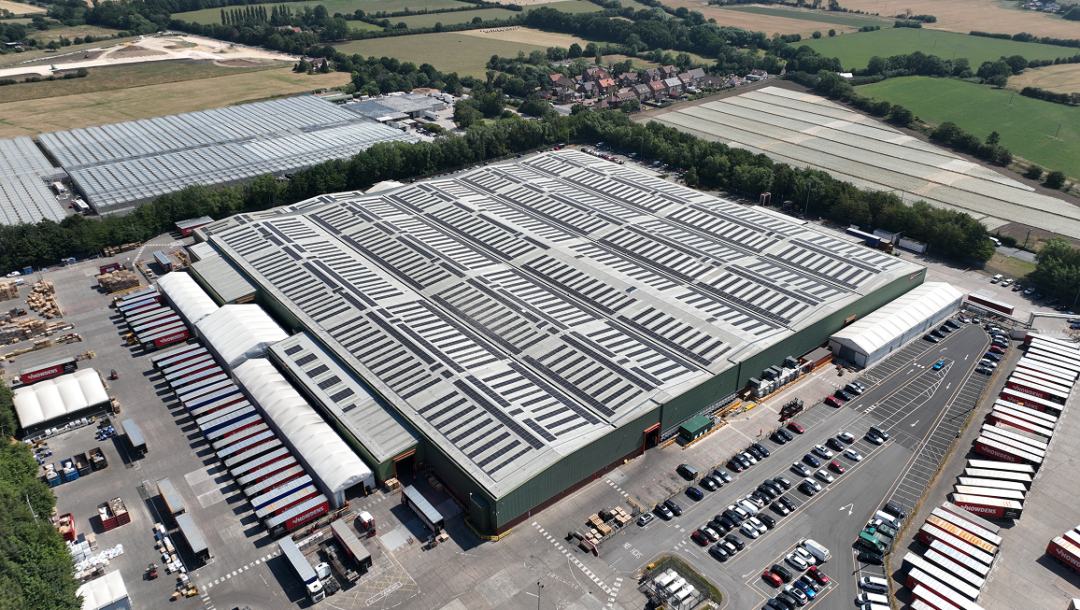
We delivered a 2.965 MWp rooftop solar PV system for Howdens at its manufacturing site in Goole, supporting the company’s long-term energy and carbon reduction strategy. The installation comprises 6,816 Trina 435W panels, 22 SolarEdge inverters and a K2 Multi Rail mounting system, creating what is understood to be the largest SolarEdge installation in the UK.
The Challenge
The project was defined by the complexity of the site, not just the scale of the solar installation. Howdens Goole is a large industrial manufacturing campus operating across multiple buildings, with an existing HV ring, an on-site CHP system, an export limitation and a minimum import agreement requiring 430 kW of grid import. These factors meant the project had to be designed around the way the whole site consumes, generates and controls energy, rather than being treated as a standalone rooftop PV scheme.
Howdens also has a long-term objective to turn off CHP by 2030. This made the project strategically important, because the existing CHP forms part of the site’s operational energy profile and cannot simply be removed without understanding the impact on cost, carbon and resilience. Our role was therefore to deliver a renewable generation asset that provides immediate benefit, while also creating a credible pathway for the next phase of decarbonisation.
Our Solution
We connected the solar PV system into the site’s HV ring, allowing renewable electricity to be distributed across the wider campus instead of being limited to one building. This was particularly important because the site is export limited. In that context, the value of solar depends on how much generation can be consumed on site, rather than exported or curtailed. By integrating at HV level, we helped Howdens maximise the use of solar generation across its operational estate and created an electrical foundation that future energy technologies can build on.

Alongside the installation, we carried out detailed feasibility modelling using Howdens’ half-hourly energy data. Our in-house modelling assessed 15 different scenarios, showing how solar PV, CHP, future battery storage, grid import requirements and export limitations would interact over time. This allowed Howdens to understand the commercial and carbon impact of different operating strategies before committing to future phases.
The modelling was especially important because the site’s constraints create competing priorities. The minimum import agreement means the site must continue to import a defined level of electricity from the grid, while the export limitation restricts how much surplus generation can be sent back. At the same time, CHP reduction changes the site’s demand profile and the role that solar and battery storage will need to play. By modelling these interactions, we were able to show how each element of the energy system could work together, and how the next phase should be sequenced to avoid unnecessary curtailment, wasted investment or compliance risk.
The Result
The completed system is forecast to generate 2,437,603 kWh of renewable electricity each year, saving an estimated 567,661 kg of CO₂ annually. These savings are significant in their own right, but the wider value of the project is that it establishes the basis for Howdens’ next stage of energy transformation. Future battery storage will allow the site to capture more solar generation, reduce curtailment, support CHP turndown and further optimise energy performance across the campus.
Since completion, EvoEnergy has continued to monitor and maintain the project. No post-completion issues have been identified, and the system continues to support Howdens’ objectives around energy resilience, cost reduction and operational carbon reduction.
For a complex manufacturing site operating under export limits, a minimum import agreement and a planned transition away from CHP, this project shows how industrial decarbonisation can be delivered in a practical and commercially robust way. It demonstrates that large energy users do not need to wait for perfect grid conditions before acting. With the right modelling, HV integration and phased technology strategy, complex industrial sites can make meaningful progress now while preparing for deeper decarbonisation in the years ahead.