For the first time, plug-in solar panels are legally on sale in the UK. Since 27 August 2026, anyone in England, Wales or Scotland has been able to buy a compliant kit from a major retailer, plug it into a normal wall socket, and start generating a small amount of their own electricity, no electrician, no scaffolding, no rewiring.
The coverage so far has been almost entirely aimed at homeowners and renters, and understandably so: this is a genuinely new way for households to cut their energy bills. But the arrival of any new generation technology tends to prompt the same question from a commercial audience: could this work for us too, on a bigger site, with a bigger bill to offset?
It’s a fair question, and one worth answering properly rather than assuming the answer either way. This article sets out exactly what plug-in solar panels are, how they work, and what the UK’s new rules actually allow, before turning to the question that matters most for businesses: whether an 800W socket-connected kit designed for a single household has any meaningful place in a commercial energy strategy, and what the better alternative looks like if it doesn’t.
Key Takeaways
- Plug-in solar panels became legal to buy and self-install in England, Wales and Scotland on 27 August 2026, under Statutory Instrument 2026/848 and DESNZ’s Interim Product Specification.
- Output is capped at 800VA (800W) AC per device, with up to 2,000W of panel capacity, and current G98 rules permit only one device per household or premises.
- The framework was designed and consulted on explicitly as a consumer route, aimed at households, renters and flat owners without roof access, not as a commercial energy solution.
- Government estimates put household savings at up to £110 a year, covering up to 20% of an average home’s electricity use; this is negligible against typical UK business electricity consumption of 10,000 kWh or more a year.
- Plug-in solar cannot be paired with a battery, cannot earn Smart Export Guarantee payments, and provides no backup power during an outage.
- “Balcony solar” is the same technology, most relevant to businesses in the role of landlord, freeholder or managing agent handling tenant consent and fire-safety obligations, rather than as an energy-saving tool for the business itself.
- Businesses seeking real energy cost savings from solar should pursue a G99-connected commercial solar PV system, sized to their actual consumption and roof or ground space, with EvoEnergy’s own data showing typical payback of 7 to 12 years on large-scale systems.
TL;DR
Plug-in solar panels are small, socket-connected solar kits that became legal to buy and self-install in Great Britain on 27 August 2026. They are capped at 800W of AC output, limited to one device per household under Engineering Recommendation G98, and were designed specifically for domestic consumers, particularly renters and flat owners. For businesses, the household-scale cap makes plug-in solar unsuitable as a meaningful energy strategy. Commercial solar PV, sized in tens or hundreds of kilowatts, remains the appropriate route for reducing a business’s electricity costs.
What Are Plug-In Solar Panels?
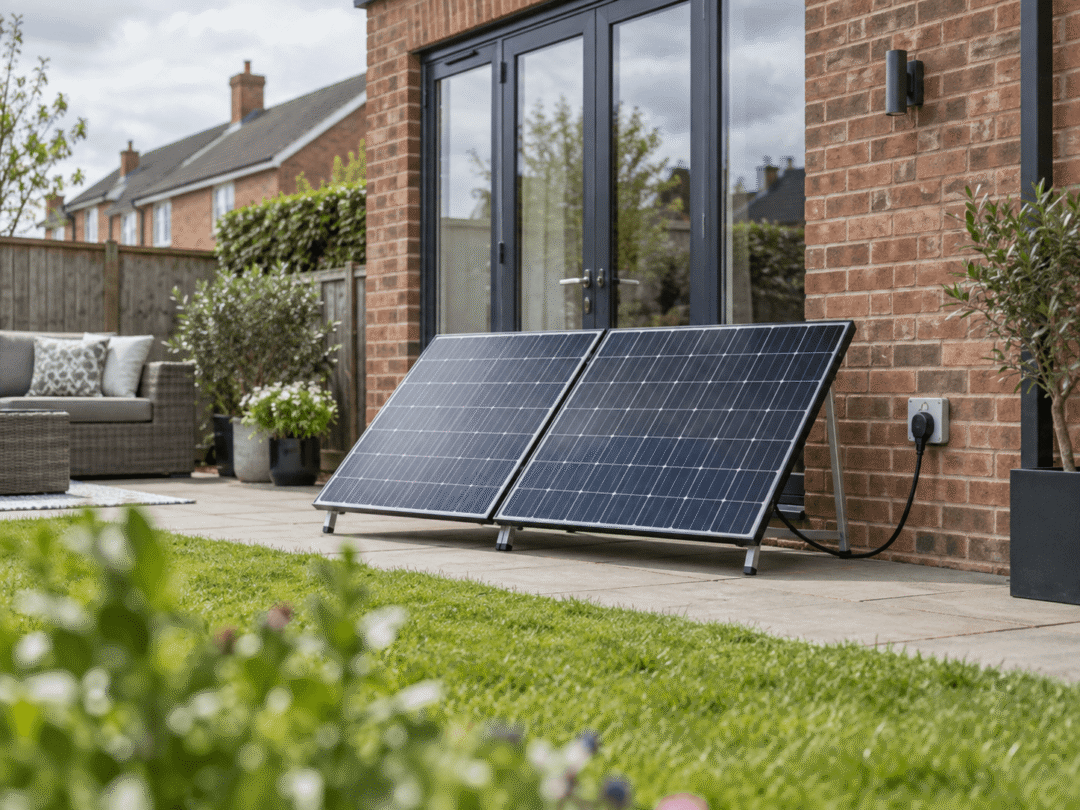
Plug-in solar panels are small, self-contained solar photovoltaic (PV) kits that connect directly to a standard UK three-pin socket rather than being wired into a property’s consumer unit. They typically consist of one to four solar panels, a small microinverter, and a manufacturer-supplied cable terminating in a BS 1363 plug.
The UK government’s Department for Energy Security and Net Zero (DESNZ) defines these products as “plug-in microgenerators”: small solar PV systems, without batteries, designed to connect directly to a standard UK mains socket and operate alongside the electricity network. Until 27 August 2026, this route did not legally exist in Great Britain. Plug-in solar has been common in Germany, Spain and the Netherlands for years, and DESNZ’s own consultation noted that Germany alone saw around half a million new devices installed in a single year before the UK caught up.
These products are also frequently marketed as balcony solar panels, because a mounting frame or bracket that clips onto a balcony rail is one of the most common installation methods for flat-dwellers and renters who have no roof of their own to use. Electrical Safety First, the UK charity dedicated to preventing electrical accidents, uses “balcony-solar” and “plug-in solar” interchangeably in its own consumer guidance for exactly this reason.
How Do Plug-In Solar Panels Work?
A plug-in solar panel generates DC electricity from sunlight, converts it to AC through a small microinverter, and feeds that AC power directly into the property’s electrical circuit via a standard wall socket, where it is consumed by whatever appliances are running at the time.
The system does not export electricity to the grid for payment and does not store it in a battery. It simply offsets a small amount of grid consumption while the sun is shining. Three technical features make this possible within existing UK wiring:
- Anti-islanding protection. The inverter automatically disconnects within milliseconds if it detects a loss of mains supply, preventing it from energising a circuit during a power cut, which would be dangerous for network engineers.
- Output limitation. UK-compliant devices are capped at 800VA (800W) of AC output at the inverter, regardless of how much solar capacity is fitted to the panels themselves.
- A dedicated approved plug. Because BS 1363, the standard governing UK plugs, previously prohibited using a plug to connect generating equipment to a socket, DESNZ had to amend the Plugs and Sockets etc. (Safety) Regulations 1994 to create a narrow, specific approval route for compliant plug-in solar devices.
In practice, this means a plug-in solar kit behaves less like a generator and more like a very efficient appliance that quietly reduces the amount of electricity drawn from the grid during daylight hours. Electrical Safety First’s guidance also flags that not every home is electrically suitable: the type of RCD (residual current device) protecting a property’s circuits affects whether a plug-in device can be safely connected at all, which is worth bearing in mind for any commercial premises with a domestic-style connection considering the same route.

Are Plug-In Solar Panels Legal in the UK?
Yes. Plug-in solar panels became legal to buy, sell and self-install in England, Wales and Scotland on 27 August 2026, provided the specific kit is a compliant, registered product. Northern Ireland is not covered, as it operates under separate electricity safety regulations.
This is a genuinely new regulatory framework, and the timeline matters for anyone assessing product compliance:
| Date |
Development |
| 24 March 2026 |
Government announces intention to legalise plug-in solar as part of the Clean Power 2030 mission |
| 16–30 June 2026 |
DESNZ runs a public consultation on amendments to the Plugs and Sockets etc. (Safety) Regulations 1994 and a new Interim Product Specification (IPS) |
| 15 April 2026 |
BS 7671 Amendment 4 (IET Wiring Regulations) updates Chapter 712 to recognise small plug-connected PV sources |
| 16 July 2026 |
DESNZ publishes its government response and the final Interim Product Specification, based on the German standard DIN VDE V 0126-95 |
| 11 August 2026 |
Ofgem approves the corresponding amendment to Engineering Recommendation G98 |
| 27 August 2026 |
Statutory Instrument 2026/848 comes into force; compliant plug-in solar becomes legal to sell and self-install |
Sources: DESNZ, Plug-in solar: consultation document, gov.uk; DESNZ, Plug-in solar: Government Response, July 2026 (PDF); gov.uk, Households can save as plug-in solar panels come to market, 27 August 2026.
In short, this is a fast-moving framework that only became operative a few weeks before this article was published. Anyone advising on plug-in solar, whether for domestic or commercial premises, should verify current requirements against gov.uk before relying on older commentary.
Only kits that meet the Interim Product Specification and appear on the Energy Networks Association’s Type Test Register are lawful. DESNZ’s government response was explicit that the framework covers plug-in solar only. Plug-in batteries, hybrid solar-plus-storage kits and other forms of plug-in microgeneration remain outside the scope of the legislation and are not legal to connect under this route. It is also worth noting that a joint statement from the Electrical Contractors’ Association, Electrical Safety First, the IET, NICEIC and SELECT, issued on 9 June 2026, urged government to move carefully on rollout, citing concerns about older UK wiring and product quality control, a caution that applies equally to any business weighing up self-installation.
What Are the Technical Limits on Plug-In Solar Panels?
A compliant plug-in solar system is capped at 800VA (800W) of AC output at the inverter, up to 2,000W of panel capacity, and one device per household. These limits were set deliberately low to keep the risk profile manageable for self-installation without an electrician.
Key limits under the Interim Product Specification and the amended G98:
- 800VA / 800W AC output limit, with a maximum current of 3.5A, regardless of how many panels are attached.
- Up to 2,000W of DC panel capacity across a maximum of four panels can feed a single 800W inverter; DESNZ noted in its government response that this 2,000W cap will be kept under review as real-world evidence develops.
- One plug-in solar device per household. DESNZ’s consultation considered allowing one device per individual circuit, and the majority of consultation respondents supported that more flexible approach, but the government confirmed that the one-per-household restriction in G98 continues to apply “unless and until” a corresponding G98 amendment permits otherwise.
- A dedicated, non-rewireable BS 1363 plug with a fuse rated no higher than 5A.
- Mandatory DNO notification under Engineering Recommendation G98, using a connect-first, notify-within-28-days process, rather than the prior-approval process required for larger installations.
- No batteries. A qualifying device must not be designed to import or store electrical energy.
This is the point at which the commercial suitability question becomes clear. An 800W output limit is roughly equivalent to a single domestic kettle running at partial load. It was never intended to offset a meaningful share of any organisation’s energy consumption; it was designed to offset a modest share of one household’s.
Are Plug-In Solar Panels Suitable for Businesses?
No, not as a meaningful commercial energy strategy. Plug-in solar was designed, consulted on and legislated as a consumer product for households, and its 800W cap and one-per-household connection limit make it structurally unsuited to business-scale electricity demand.
This is not a matter of opinion; it is written into the policy itself. DESNZ’s consultation document defines the aim of the reform as creating “a new, accessible route for households to generate clean electricity.” The government’s own glossary in its July 2026 response defines a plug-in microgenerator as a system “designed to be connected directly to a standard UK mains socket to generate electricity for use in the home.” Businesses were consulted as stakeholders in the process, alongside retailers, manufacturers and insurers, but the product itself was never framed as a business energy solution.
There is also a practical grid connection reason this matters. UK generation connections are governed by two Engineering Recommendations: G98, for fully type-tested microgenerators up to 16A per phase (3.68kW single-phase, or around 11kW three-phase), which allows a simple connect-and-notify process, and G99, for anything larger, which requires a formal application and DNO approval before connection. Plug-in solar sits at the extreme low end of the G98 band. Any commercial installation above 50kW, and most below it, exceeds this threshold and is designed, assessed and connected under G99 from the outset, exactly as EvoEnergy’s own analysis of large-scale commercial solar sets out.
That said, plug-in solar is not entirely irrelevant to every commercial context. A sole trader working from home, or a very small business operating from a residential-style unit with its own household-type electricity connection, could in principle use one compliant 800W kit in the same way a domestic consumer would. But this is a marginal use case, not a route to reducing a business’s energy bill in any measurable way.
How Much Electricity Can a Plug-In Solar Panel Generate, and How Does That Compare to Business Energy Use?
An 800W plug-in solar kit generates roughly enough electricity to cover up to 20% of an average UK home’s electricity use, according to DESNZ. That is a rounding error against typical commercial electricity consumption.
DESNZ’s own launch materials illustrate the household-scale expectation directly: an 800W kit produces enough power, at peak output, to run “a typical fridge, television, Wi-Fi router, laptop, phone charger and an Xbox S operating at once when the sun is shining.” The department estimates savings of up to £110 a year for a household, against average UK household electricity consumption of around 3,323 kWh in 2024.
Independent UK business energy benchmarking, compiled by comparison services such as Bionic and Uswitch from supplier and Ofgem-aligned data, gives a sense of scale for comparison:
| Business size |
Typical annual electricity use |
| Micro business |
~10,000–15,000 kWh |
| Small business |
~20,000–25,000 kWh |
| Medium business |
~25,000–50,000 kWh |
| Large business |
50,000 kWh+ |
For genuine commercial-scale context, EvoEnergy’s own guide to large-scale commercial solar installations shows what a properly sized system delivers by comparison: a 100kWp rooftop system generates around 85,000 kWh a year, a 250kWp system around 212,500 kWh, and a 500kWp system around 425,000 kWh. Even a single plug-in solar kit generating its maximum realistic output of roughly 650–800 kWh a year, the figure DESNZ’s own impact assessment works from, would cover well under 10% of a micro business’s annual electricity use, and a small fraction of a percent for a medium or large site. For context, businesses cannot even connect more than one plug-in device to offset this gap, since the one-per-household G98 limit applies to non-domestic premises using the plug-in route in the same way it applies to homes.
There is one further limitation worth flagging directly. Plug-in solar cannot currently earn export payments. The Smart Export Guarantee (SEG) requires Microgeneration Certification Scheme (MCS) accreditation of the installation, and self-installed plug-in kits are not MCS-certified. Any generation a business does not use instantly is simply lost.

What Is Balcony Solar, and Could It Work for Mixed-Use or Multi-Occupancy Business Premises?
Balcony solar is the same plug-in solar technology mounted on a balcony rail, wall or outdoor structure rather than a garden frame, and it is most relevant to businesses that manage flats, offices or mixed-use buildings with balconies rather than to the businesses themselves.
Because plug-in solar was designed for renters and flat owners without roof access, mounting on a balcony rail is one of the two most common installation types alongside free-standing garden frames. This is directly relevant to two categories of UK organisation:
- Managing agents, freeholders and housing associations overseeing blocks of flats where tenants or leaseholders want to install plug-in kits on their own balconies.
- Landlords of mixed-use buildings, where flats sit above commercial units, and questions of consent, liability and building safety cross over between residential and commercial responsibilities.
DESNZ’s consultation response flagged specific building-safety concerns relevant to this scenario. A minority of respondents raised the risk of panels mounted on balconies or facades in multi-occupancy buildings posing a fire or falling-object risk, and the government responded by strengthening fire performance requirements for PV module backing materials and adding restrictions on installation surfaces for higher-risk buildings. Electrical Safety First’s own consumer guidance reinforces this: not every home, or by extension every building, has electrical protection suitable for a plug-in device, and the type of RCD fitted needs checking before installation. The government’s consumer guidance also makes clear that renters, leaseholders and residents of managed buildings should obtain landlord or freeholder consent before installing a plug-in device.
For a business in this position, the practical task is not installing plug-in solar as an energy strategy, but developing a clear policy: what consent process applies, which elevations or surfaces are acceptable, how installations are recorded, and how fire risk assessments account for balcony-mounted panels across the building.
What Are the Risks and Limitations for Businesses Considering Plug-In Solar?
Beyond the output cap, businesses face practical, financial and insurance limitations that make plug-in solar a poor substitute for proper commercial solar PV.
- No backup power. Anti-islanding protection means plug-in solar shuts down the moment mains supply is lost, so it provides no resilience during a power cut, unlike a properly designed commercial system paired with battery storage.
- No battery integration. The current legal framework excludes batteries entirely, so there is no way to shift generation to cover evening or weekend demand, which is when many commercial premises, such as retail units and hospitality venues, use the most electricity.
- No export revenue. As noted above, plug-in solar cannot access the Smart Export Guarantee.
- Insurance and liability questions. DESNZ’s consultation response noted that landlords carry clear legal responsibility for building and fire safety following the Grenfell Tower disaster, which will influence how commercial landlords and managing agents treat consent requests for balcony-mounted panels.
- One device per premises. A single 800W kit cannot be scaled up by adding more units to the same connection under current G98 rules, so there is no incremental path from a plug-in kit to a meaningful commercial installation; a business genuinely interested in solar has to make the jump to a proper G99-connected system regardless.
- Product compliance risk. DESNZ’s own commissioned safety study found variation between products in areas such as electromagnetic compatibility, and warned that only kits verified on the ENA Type Test Register should be treated as lawful. A business installing an uncertified kit purchased online carries direct compliance exposure. Electrical Safety First has separately warned that no international or UK product safety standard yet exists for the complete plug-in solar assembly, only for individual components, which is a further reason to treat any purchase with caution.
What Should Businesses Do Instead of Plug-In Solar?
Businesses looking to reduce electricity costs through solar generation should pursue a properly designed commercial solar PV system, sized to the site’s roof space, energy consumption profile and connection capacity, and connected under G99.
Commercial solar operates on an entirely different scale and a different regulatory track to plug-in solar, but it addresses the same underlying goal: reducing exposure to grid electricity prices. EvoEnergy’s own analysis shows commercial rates climbed from around £0.14/kWh in 2021 to over £0.28/kWh by 2024, a shift that has driven a 34% year-on-year surge in UK commercial solar installations. Options include:
- Rooftop solar PV, typically costing £700 to £900 per kWp installed. For large-scale systems, EvoEnergy’s own figures show annual savings ranging from roughly £23,800 for a 100kWp system to around £119,000 for a 500kWp system, with payback typically running 7 to 12 years and a system lifespan of 25 to 30 years.
- Ground-mounted solar, where roof space or roof condition is a constraint, and land is available instead.
- Solar carports, which combine generation with EV charging infrastructure over car parking areas, a popular dual-use option for retail parks, corporate campuses and logistics sites.
- Battery storage, added to capture and shift generation to periods of higher demand or higher grid pricing; EvoEnergy’s data shows self-consumption typically rising from 30–40% without storage to 60–70% with a correctly sized battery system.
These systems are engineered around the business’s actual half-hourly consumption data, structural roof or ground conditions, and DNO connection capacity, which is precisely the assessment that plug-in solar was designed to avoid needing. EvoEnergy’s consultancy service covers exactly this kind of feasibility and design work, and the free Solar Output Calculator gives an initial estimate of what a given roof or site could generate.
Plug-In Solar vs Commercial Solar PV: How Do They Compare?
|
Plug-in solar |
Commercial solar PV |
| Typical output |
Up to 800W AC per device |
Tens to hundreds of kW, or MW for large sites |
| Connection route |
G98, connect-and-notify, one device per premises |
G99, formal DNO application and approval |
| Installation |
Self-install, no electrician required |
Designed and installed by qualified engineers |
| Battery storage |
Not permitted under current rules |
Fully supported, sized to demand |
| Export payments |
Not eligible (no MCS certification) |
Eligible via the Smart Export Guarantee, MCS-certified |
| Typical annual output |
Roughly 650–800 kWh |
Tens of thousands to millions of kWh, depending on system size |
| Designed for |
Individual households, renters, flat owners |
Commercial, industrial and public sector energy demand |
| Typical UK cost |
From around £450–£600 for a kit |
Approximately £700–£900 per kWp installed |
In summary, plug-in solar and commercial solar PV solve different problems at completely different scales. One offsets a modest share of a single household’s electricity bill; the other is engineered to materially reduce a business’s exposure to grid electricity costs over a 20-plus year asset life.
Ready to Cut Your Business’s Energy Costs the Right Way?
Plug-in solar has a genuine role to play in UK homes, but as this article has shown, it was never designed to move the needle on a business’s electricity bill. For organisations serious about reducing energy costs and carbon emissions, the opportunity lies in properly engineered, G99-connected commercial solar, whether that is rooftop, ground-mounted or carport generation, paired with battery storage where the load profile justifies it.
EvoEnergy has been delivering commercial solar PV, battery storage, EV charging and smart grid solutions across the UK since 2007, with over 10,000 completed projects and more than 3,500 assets currently under management. Whether you are exploring solar for the first time or comparing it against battery storage, our team can model what a correctly sized system would actually deliver for your site, with no obligation.
Get a free solar feasibility assessment from EvoEnergy and find out what your roof, land or car park could really be worth.
Frequently Asked Questions
What are plug-in solar panels?
Plug-in solar panels are small solar PV kits, usually one to four panels and a microinverter, that connect directly to a standard UK socket instead of being wired into a consumer unit. They are also known as balcony solar panels and were designed as a low-cost, self-install option for households without roof access.
Are plug-in solar panels legal in the UK?
Yes, as of 27 August 2026, provided the kit is a compliant product registered on the Energy Networks Association’s Type Test Register and the installation follows the required DNO notification process under G98. Northern Ireland is not currently covered.
Why are plug-in solar panels suddenly appearing in the UK?
DESNZ amended the Plugs and Sockets etc. (Safety) Regulations 1994 and introduced an Interim Product Specification, removing the legal barrier that previously stopped generating equipment from being connected through a standard plug. The reform followed years of plug-in solar being widely used across Germany, Spain and the Netherlands with no lawful UK equivalent.
How much do plug-in solar panels cost in the UK?
Compliant kits are appearing from major UK retailers including Screwfix, Currys, B&Q and Argos, with entry-level prices reported from around £450 to £600 depending on the manufacturer and panel configuration.
Can a business install more than one plug-in solar device?
No. Current G98 rules limit installations to one plug-in solar device per household or premises, regardless of how many sockets or circuits are available.
Do plug-in solar panels need a qualified electrician to install?
No, they are designed for self-installation by the consumer, connecting via a standard socket without any wiring alterations. DNO notification under G98 is still required after installation.
Can plug-in solar panels be used with a battery?
No. The current legal framework excludes battery storage entirely. A device must not be designed to import or store electrical energy to qualify as a lawful plug-in microgenerator.
What is the difference between plug-in solar and balcony solar?
They are the same underlying technology. “Balcony solar” typically refers to a plug-in solar kit mounted on a balcony rail or wall bracket, one of the most common configurations for flat-dwellers and renters without garden or roof access.
Are plug-in solar panels suitable for businesses?
Generally, no. The 800W output cap and one-device-per-premises limit were designed around a single household’s electricity use, so plug-in solar cannot deliver a meaningful reduction in a business’s energy costs, except in the marginal case of a sole trader on a household-style connection.
How does plug-in solar compare with commercial rooftop solar?
Plug-in solar tops out at 800W and around 650–800 kWh a year, self-installed with no battery and no export income. Commercial rooftop solar starts at roughly 50kWp, is professionally designed and G99-connected, supports battery storage, and can generate tens of thousands of kWh a year or more.
What can businesses learn from the rise of plug-in solar?
The speed of this reform shows how quickly UK energy policy is moving to widen access to onsite generation, and how strong consumer demand for cutting electricity costs has become. For businesses, the lesson is less about the product itself and more about the direction of travel: onsite generation is increasingly the default expectation, not a fringe option.
Why does onsite generation matter more at commercial scale?
Because commercial electricity consumption and unit costs are both far higher than domestic, even a modest percentage reduction in grid reliance translates into substantial savings. EvoEnergy’s own figures show a 500kWp system can save a large site around £119,000 a year, a scale of benefit that no household-oriented product could ever approach.
When should a business consider solar PV, battery storage, or both?
Solar alone tends to pay back fastest per pound invested and suits businesses with high daytime consumption. Adding battery storage extends self-consumption into evenings and peak-tariff periods but adds significant upfront cost, so the right mix depends on a site’s load profile; EvoEnergy’s comparison of solar panels with and without battery storage and its guide to which to invest in first cover this in detail.
How can businesses determine the right solar system size?
System size should be based on half-hourly consumption data, available roof or ground space, and structural or DNO connection constraints, not a generic rule of thumb. EvoEnergy’s Solar Output Calculator provides an initial estimate, with a full feasibility assessment refining this further.
What is the next step for businesses considering onsite generation?
The most reliable next step is a professional feasibility assessment covering roof or land survey, consumption analysis, and DNO connection capacity, rather than attempting to scale up a consumer product. EvoEnergy’s consultancy team can produce a detailed feasibility report, typically within two weeks of an initial enquiry.