Data centre operators across the UK are hitting the same wall. Power, not land, capital or fibre, now decides what gets built and when.
The practical answer is not to wait for the grid. It is to generate on site where you can, store what you can shift, and treat electrical infrastructure as part of the same system. Solar for data centres sits at the centre of that approach, though it works very differently here than it does in a warehouse or a factory.
This guide sets out what solar realistically delivers for a UK data centre, what it costs, how it interacts with grid connection reform, and what installing it on a live Tier III facility actually involves. The figures are specific and sourced. Where the honest answer is unhelpful to a solar company, we have given it anyway.
EvoEnergy has delivered more than 10,000 renewable energy projects since 2007 and manages over 3,500 assets across the UK, including installations on operationally critical and security-sensitive sites.

Key Takeaways
- Rooftop solar typically offsets 1% to 3% of a UK data centre’s annual electricity use. It is a cost and carbon lever, not a full power supply.
- Ground mount and solar carports on adjacent land can push on-site generation considerably higher where space allows.
- Self-consumption approaches 100%. Data centres run a flat 24/7 baseload, so every kilowatt-hour generated is absorbed on site.
- Solar reduces grid import at a time when the GB demand connection queue sits at roughly 125GW of requested capacity.
- Battery storage shifts generation into peak charging windows and strengthens site energy management.
- On-site generation is the strongest evidence available for 24/7 carbon-free energy matching, because it is physically and temporally aligned with consumption.
- Most operators combine routes: on-site PV for daytime cover, plus an off-site PPA for the remaining hours.
What is solar for data centres?
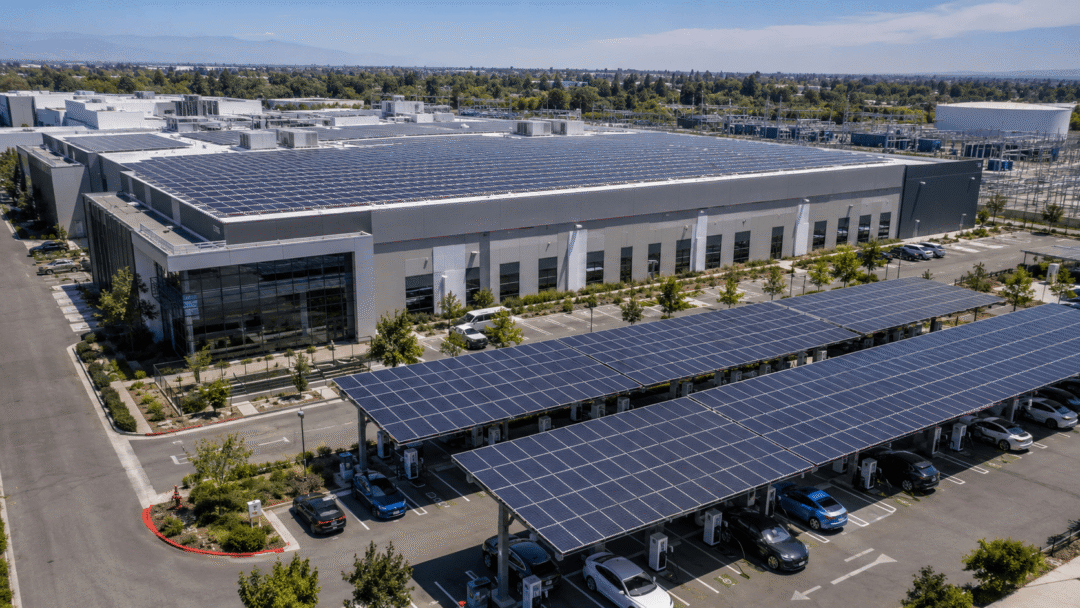
Solar for data centres means installing photovoltaic generation on or near a data centre to offset grid-imported electricity. It is deployed on rooftops, over car parks, on adjacent land, or through a private wire connection to a nearby solar farm.
The technology is identical to any commercial solar installation. What changes is the load profile it serves, the operational constraints of the building, and the scale mismatch between roof area and power demand.
There are five practical routes, and the right one depends on your site geometry, not your preference.
| Deployment route |
Typical scale |
Best suited to |
Key constraint |
| Rooftop PV |
250kWp to 2MWp |
Existing facilities with spare roof area |
Cooling plant, structural loading, access routes |
| Solar carports |
100kWp to 1MWp |
Sites with staff or visitor parking |
Civils cost, planning permission |
| Ground mount |
1MWp to 20MWp+ |
Campus sites with adjacent land |
Land availability, planning, DNO capacity |
| Private wire |
5MWp to 50MWp+ |
New builds sited near generation |
Wayleaves, land agreements, capital |
| Corporate PPA (off-site) |
Unlimited |
Any operator with Scope 2 targets |
Delivers no local grid capacity benefit |
One distinction matters more than any other, and most content on this topic blurs it.
- Behind the meter generation connects on your side of the supply meter. It directly reduces the electricity you import and pay for. This is where the financial case lives.
- In front of the meter generation exports to the grid. It supports your carbon accounting through contractual matching, but does nothing for your metered import or your local capacity position.
For a data centre, behind the meter is almost always the priority. Explore the technical options for rooftop solar, ground mount systems and solar carports.
Why is UK data centre energy demand growing so fast?
UK data centres already consume around 2.5% of national electricity, and the sector’s consumption is forecast to rise four-fold by 2030. Government wants at least 6GW of AI-capable capacity in place by the same date, which is why grid capacity has become the binding constraint on the sector.
The growth is not speculative. It is already visible in connection applications, planning submissions and national infrastructure planning. Two policy developments have reshaped the landscape for operators.
- Critical National Infrastructure designation. In September 2024, the UK government classified data centres as Critical National Infrastructure, placing them alongside energy and water. It was the first new CNI designation since 2015. The practical consequence for estates teams is elevated expectations around resilience, security and contractor vetting on every project touching the facility.
- AI Growth Zones. Government has designated priority development areas with accelerated planning and grid access. Culham in Oxfordshire is the pilot site, with further zones at Cobalt Park in North Tyneside, Blyth in Northumberland, and sites at Anglesey and Trawsfynydd in Wales. A dedicated delivery unit launched in January 2026.
Can solar realistically power a data centre?
No. Rooftop solar alone typically offsets 1% to 3% of a UK data centre’s annual electricity consumption. Solar is a cost, carbon and capacity-headroom lever, not a replacement for a grid connection.
The reason is structural. A data centre concentrates enormous power demand into a small building footprint, while solar generation is a function of area. No amount of panel efficiency closes a gap of that size on a roof.
So why does anyone bother? Because the percentage is the wrong metric.
- The absolute saving is substantial. 950MWh displaced at commercial import rates represents a six-figure annual reduction, locked in against price volatility for 25 years or more.
- Self-consumption is effectively total. Data centres draw a flat baseload day and night, so generation is always absorbed. There is no export loss and no curtailment risk. Very few sectors achieve this.
- Every displaced kilowatt-hour creates headroom under an existing agreed supply capacity.
- Land changes everything. A campus with several acres available can host multi-megawatt ground mount generation, which moves the offset into double figures as a percentage.
Model your own site with the EvoEnergy solar output calculator before committing to any feasibility spend. These figures are indicative. Actual performance depends on latitude, roof orientation, shading, plant layout and facility PUE.
What are the benefits of solar for data centres?
Solar reduces cost on a facility’s single largest operating expense, cuts Scope 2 emissions with directly time-matched generation, and lowers grid import at a point when connection capacity is severely constrained. The benefits are specific rather than general, and each one is worth separating.
- Cost certainty on a volatile input. Energy dominates data centre opex. On-site generation fixes part of that cost for the system’s 25 year-plus operating life.
- Near-total self-consumption. A flat, continuous baseload means output is always used. No export arrangement is needed and no generation is wasted.
- Seasonal load alignment. Cooling demand rises through summer, in exactly the months and hours when solar output peaks. Generation lands when the facility draws hardest.
- Capacity headroom. Reduced import can defer or reduce the scale of a distribution network reinforcement application.
- Defensible Scope 2 reporting. On-site generation is physically and temporally matched to consumption, making it the strongest form of evidence in a carbon-free energy claim.
- Tenant and customer requirements. Colocation clients increasingly write renewable provisions into contracts, and hyperscale tenants operate to published 100% renewable commitments.
- Planning and community position. Visible on-site generation supports applications in areas where data centre development attracts local objection.
For a broader view of how these connect to organisational targets, see EvoEnergy’s guidance on reducing your company carbon footprint.
How does solar help with the UK grid connection queue?
Solar reduces the volume of electricity a site imports, which can lower the capacity a facility needs to request or free headroom under an existing agreement. It does not remove the need for a connection, but it can improve a project’s position.
Requested data centre capacity alone now exceeds the entire peak demand of Great Britain. That is the context every connection application sits inside.
Ofgem’s reform programme is live and moving. The regulator is running demand connections reform across three workstreams, known as Curate, Plan and Connect, designed to clear speculative applications and prioritise credible projects. Key proposals from the Curate consultation published on 29 July 2026 include:
- A returnable data centre commitment fee for projects above a 40MW threshold, held from connection offer acceptance through to energisation.
- Expanded self-build of high voltage assets, allowing developers to construct their own HV infrastructure rather than waiting for network operators.
- Ramped and flexible connection agreements, letting operators energise capacity in phases as modular build-out progresses.
Two of those three point in the same direction for operators. Self-build and phased energisation both require an engineering partner with genuine high voltage capability, not just panel installation experience. EvoEnergy delivers HV/LV infrastructure upgrades alongside generation as a single scope.
How does battery storage change the case for solar?
Battery storage shifts electricity into high-cost charging periods and gives the site a controllable asset. For data centres the case is built on peak shaving and capacity management rather than on storing surplus solar, because surplus is rare.
This is where data centre storage economics diverge from every other commercial sector.
In a warehouse, batteries store excess solar that would otherwise export. In a data centre, baseload always exceeds generation, so there is nothing to store from the array. The value comes from elsewhere.
- Peak shaving. Discharging during high network charging windows reduces non-commodity costs, which now represent a large and growing share of a business electricity bill.
- Capacity management. Storage allows a site to serve short-duration high loads without increasing its agreed supply capacity, which can avoid a reinforcement application entirely.
- Grid services revenue. Where the asset is sized and controlled appropriately, participation in flexibility markets creates a secondary income stream.
- Load smoothing across AI training workloads, which produce far spikier demand profiles than traditional colocation.
One important limit. Battery storage supports resilience but does not replace N+1 UPS and standby generation on a Tier III or Tier IV facility. Any supplier presenting a BESS as a UPS substitute on a concurrently maintainable site is overselling it.
The technologies only deliver together when they are controlled together. A smart grid management layer coordinates generation, storage and site load as one system. Learn more about commercial battery storage.
How much does solar for data centres cost?
Solar on a data centre costs more per kilowatt installed than an equivalent warehouse system, because the work must be delivered on a live, mission-critical facility without interruption. Funding routes include outright purchase, lease, green loan, or a power purchase agreement requiring no capital at all.
Understanding the cost premium helps you assess quotes properly. What drives the difference:
- Continuity requirements on a concurrently maintainable facility
- Restricted or excluded hot works near critical infrastructure
- Ballasted mounting to avoid any roof penetration
- Phased commissioning and staged energisation
- Integration with existing switchgear and DCIM without compromising redundancy
- Elevated security screening for personnel under CNI designation
- CDM 2015 duties on all but the smallest projects
A quote that matches standard commercial rates has probably not priced these in.
| Funding route |
Upfront capital |
Ownership |
Best suited to |
| CAPEX |
Full |
You |
Operators with balance sheet capacity seeking maximum lifetime return |
| Lease to own |
None |
You, at end of term |
Preserving working capital while retaining eventual ownership |
| Green loan |
None |
You |
Operators with sustainability-linked finance available |
| Power purchase agreement |
None |
Third party |
Zero capex, fixed unit rate below grid import |
For colocation operators, the PPA route often fits best. It removes balance sheet impact, and long-term energy contracting is already familiar territory for the sector.
One further point worth checking. Solar generally attracts business rates exemption where the system is owned by the rate-payer and the electricity is self-consumed. Treatment varies for landlord-owned private wire arrangements supplying tenants, so seek written confirmation from the Valuation Office Agency rather than assuming.
Compare all routes on the EvoEnergy finance page, or read more about solar power purchase agreements.
What are the technical challenges of installing solar on a live data centre?
The core challenge is delivering a complete electrical installation on a facility that cannot go offline. Roof congestion, structural loading, redundancy requirements and DNO approval all shape what is achievable.
Each constraint has an engineering answer, but only if it is identified before design freeze rather than during installation.
| Challenge |
Why it matters |
Mitigation |
| Zero downtime requirement |
Tier III and IV facilities have concurrent maintainability obligations |
Sequenced installation and phased commissioning designed in from the start |
| Roof congestion |
Chillers, AHUs and dry coolers occupy large areas and need access |
Plant clearance mapping before capacity is estimated |
| Structural loading |
Roofs specified for cooling plant are not automatically suitable for distributed PV load |
Full structural survey as a prerequisite |
| Wind uplift |
Ballasted systems require correctly calculated edge exclusion zones |
Site-specific wind loading calculation |
| Electrical integration |
Connection must not compromise N+1 redundancy |
LV integration design preserving all redundant paths |
| Hot works restrictions |
Standard techniques are typically excluded near critical infrastructure |
Pre-assembled components, cold-work methodology |
| Capacity agreement interaction |
Behind-the-meter generation can trigger contractual capacity recalculation |
Review supply contract before design freeze |
| G99 approval |
Systems above 100kW require formal DNO application |
Early submission, often the longest project dependency |
| Security and vetting |
CNI designation raises contractor screening requirements |
Pre-cleared, certified delivery teams |
This is where contractor selection stops being about price. EvoEnergy holds ISO 14001 accreditation and Cyber Essentials certification, the latter being directly relevant to organisations working on CNI-designated data infrastructure. The company has delivered complex installations in secure operational environments, including airside work at a major UK airport.
Turn your data centre into an energy asset, not just a load
Solar for data centres will not take your facility off grid. It will reduce the largest line in your operating cost base, strengthen the most scrutinised part of your Scope 2 reporting, and create capacity headroom at a moment when capacity is the scarcest thing in the sector.
The operators getting real value are not treating solar as a standalone purchase. They are treating generation, storage, HV/LV infrastructure and smart control as one integrated system, designed together and delivered by one team.
That is what EvoEnergy does. As a full turnkey provider covering consultancy, engineering design, installation, monitoring, maintenance and optimisation, we take responsibility for the whole system rather than one component of it.
Explore our data centre energy solutions to see how integrated renewable infrastructure works on mission-critical sites.
Make an enquiry to arrange a feasibility assessment for your facility. Our consultancy team will model your roof, land and load profile and give you real numbers before you commit to anything.
Frequently Asked Questions
Can solar panels fully power a data centre?
No. On-site solar offsets a portion of consumption, typically 1% to 3% for rooftop-only installations. Larger shares are achievable where ground mount or carport space is available on a campus site.
Do solar panels work on a roof already full of cooling plant?
Yes, but usable area is significantly reduced. A structural and plant clearance survey establishes realistic capacity before any design work begins, and 50% of gross roof area is a reasonable planning assumption.
Will installing solar require the facility to go offline?
No. Installation on a Tier III or Tier IV facility is delivered without interrupting operations, using ballasted mounting, cold-work methods and phased commissioning sequenced around your operational requirements.
Does solar help with getting a grid connection?
Indirectly. It reduces import volume and can lower the capacity a site needs to request, though it does not remove the requirement for a connection agreement.
How long does a data centre solar project take?
Timelines run from initial feasibility to energisation over several months. The G99 application to the DNO is usually the longest single dependency and should be submitted in parallel with detailed design.
Can we install solar with no upfront capital?
Yes. A power purchase agreement funds the system through a third party, with the operator buying generated electricity at a fixed unit rate typically below grid import.
How does solar affect our PUE?
It does not change PUE. Solar alters where facility power originates rather than the ratio of total facility power to IT power. The benefit appears in cost and carbon reporting instead.
What happens to the panels at end of life?
Panels are recovered and recycled under the WEEE Regulations 2013. Professional decommissioning protects both the roof fabric and the operator’s compliance position.
Is solar worth it for a colocation provider rather than an owner-occupier?
Often yes, particularly under a PPA. Tenant renewable requirements are tightening, and demonstrable on-site generation is becoming a commercial differentiator in colocation tenders.