Solar panels only or solar panels with battery storage? For most UK businesses, the honest answer is that solar alone pays back faster per pound invested, while adding a battery delivers greater total value over the life of the system, provided your site has the right load profile. The deciding factor is not the size of your roof or your budget. It is how much of the electricity you generate your business can actually use, a figure known as your self-consumption rate. This guide compares both routes on cost, payback, savings and flexibility so you can judge which delivers better value for your site.
Key Takeaways
- Solar-only systems cost less upfront and typically achieve the fastest simple payback per kWp installed
- Adding battery storage can lift solar self-consumption from a typical 30 to 50 percent to as much as 70 to 90 percent
- Batteries earn their keep on sites with evening, overnight or weekend demand, or exposure to peak-period import charges
- Battery storage unlocks savings streams solar cannot reach on its own, including peak shaving, tariff arbitrage and grid services revenue
- Battery pack prices for stationary storage fell sharply in 2025, shifting the economics in favour of combined systems
- Both routes attract capital allowances, but treatment differs by asset type and ownership model, so confirm with your tax adviser
- Twelve months of half-hourly consumption data will settle the question for your specific site
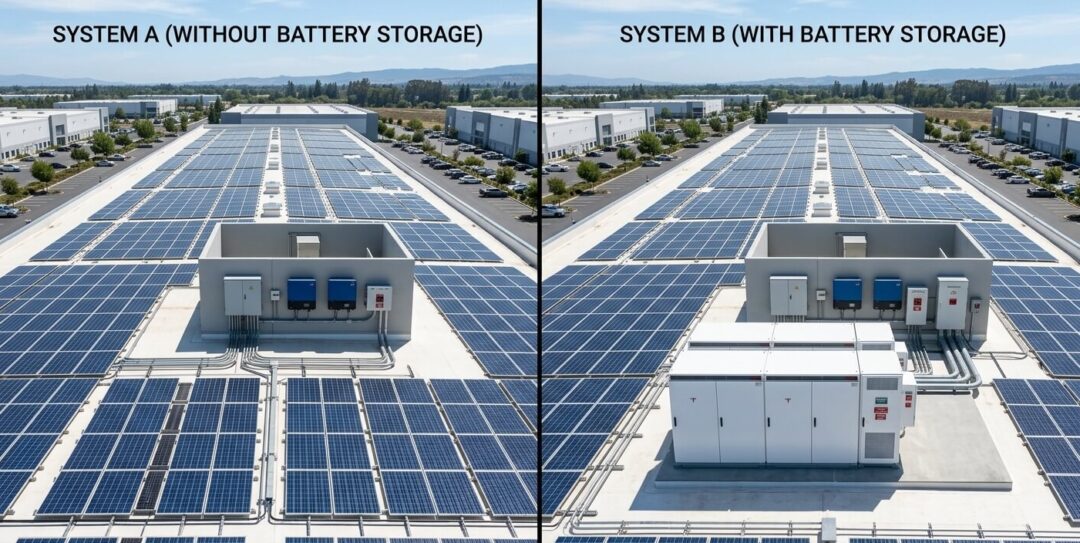
What Is the Difference Between Solar Panels Only and Solar Panels with Battery Storage?
A solar-only system generates electricity whenever daylight allows and feeds it straight into your building. Your site uses what it needs in that moment, and any surplus is exported to the grid, usually at a rate well below what you pay to import power.
Solar panels with battery storage work differently. Instead of exporting surplus generation, the system stores it in a battery energy storage system (BESS) and discharges it when the sun goes down, when demand spikes, or when import prices peak. The battery turns solar from a daytime-only asset into one that serves your operation around the clock.
There are two common configurations. New installations are usually DC-coupled or hybrid, sharing a single inverter between the panels and the battery. Existing solar systems are typically retrofitted with an AC-coupled battery, which sits alongside the original array with its own inverter. Both approaches are well proven on commercial sites, and EvoEnergy designs and installs commercial battery storage in either arrangement alongside rooftop solar PV.
How Do Costs Compare for Solar Panels with Battery Storage?
Adding storage increases upfront cost, and it is important to be straightforward about that. A battery sized to shift a meaningful share of your generation can add 30 to 60 percent to the capital cost of a solar-only project, depending on capacity and duration.
| Criteria |
Solar panels only (100 kWp) |
Solar panels with battery storage (100 kWp + 100 kWh) |
| Indicative upfront cost |
£70,000 to £90,000 |
£105,000 to £140,000 |
| Typical simple payback |
3 to 6 years |
5 to 8 years |
| Typical self-consumption rate |
30 to 50% |
70 to 90% |
| System life |
25+ years (panels) |
25+ years (panels), 10 to 15 years (battery) |
| Additional savings streams |
Avoided daytime import, export income |
Peak shaving, tariff arbitrage, grid services, backup capability |
Figures are illustrative and vary with site conditions, roof type, tariff structure and equipment specification.
The cost gap is narrowing quickly. BloombergNEF’s 2025 Lithium-Ion Battery Price Survey recorded average pack prices at a record low of $108 per kWh, with stationary storage packs falling 45 percent in a single year to $70 per kWh, the steepest drop of any segment. Batteries that looked marginal in a 2022 business case can look very different in 2026.
One more cost consideration: batteries degrade with use. A quality commercial BESS carries a warranty covering a set number of cycles or years, typically guaranteeing 70 to 80 percent of original capacity at the end of the term. Factor one battery replacement into a 25-year appraisal, and weigh the whole-life picture rather than year-one costs alone. This is why we encourage clients to compare the two options on internal rate of return and total lifetime savings, not simple payback. A CFO comparing a 4-year payback against a 6-year payback is not seeing the 20 years of larger annual savings that follow.
How Does Battery Storage Change Self-Consumption and Export Value?
Self-consumption is where the value argument is really decided.
Every kWh of solar you use on site displaces electricity you would have bought at your full import rate, including non-commodity charges. Every kWh you export earns only the export rate your supplier or PPA offtaker pays, which is usually a fraction of the import price. That gap between import and export value is the margin a battery captures.
A typical commercial site without storage self-consumes 30 to 50 percent of its solar generation. The rest is exported at low value. Add a correctly sized battery and the same site can push self-consumption to 70 to 90 percent, because the surplus generated at midday is discharged into the evening shift, the overnight refrigeration load or the next morning’s start-up.
For context on the prices being displaced, the Department for Energy Security and Net Zero publishes quarterly statistics on gas and electricity prices paid by non-domestic consumers, which show how far commercial import rates sit above typical export values. The wider that spread on your own tariff, the stronger the battery case.
EvoEnergy delivered a battery retrofit for PMK Recycling with exactly this goal, increasing the share of solar generation the site could use itself rather than export.
When Do Solar Panels Only Deliver Better Value?
Solar without storage remains the right answer for many businesses. It tends to win when:
- Daytime demand already absorbs the generation. Manufacturing plants, cold storage facilities and daytime-heavy offices often self-consume 70 percent or more of their solar output with no battery at all
- Capital efficiency is the priority. If the budget is fixed, every pound spent on panels usually generates more kWh than a pound spent on storage
- The system can grow later. Batteries retrofit well, so starting with solar and adding AC-coupled storage in two or three years is a legitimate strategy, not a compromise
- Tenure is short. If the site is leased with limited years remaining, the faster payback of solar-only reduces risk
If any of these describe your operation, a well-designed rooftop array on its own may be the better investment today. You can estimate what your roof could generate with EvoEnergy’s solar output calculator, and if capital is the constraint, funding routes such as a power purchase agreement remove the upfront cost entirely.

When Do Solar Panels with Battery Storage Deliver Better Value?
The combined system pulls ahead wherever generation and demand are out of step, or where the tariff punishes peak-time imports. The strongest cases are:
- Evening, overnight and weekend operations. Hospitality venues, logistics hubs, 24/7 production and cold chain facilities all consume heavily after the sun sets
- Half-hourly metered sites facing peak charges. Where DUoS red-band rates and capacity charges apply, discharging the battery through the peak window cuts some of the most expensive electricity a business buys
- Grid-constrained sites. If the DNO has capped your export capacity, surplus generation that would otherwise be curtailed can be stored instead, protecting the return on the panels themselves
- Resilience requirements. A battery configured for backup keeps critical loads running through an outage, something solar alone cannot do
- Flexibility revenue ambitions. Batteries can earn from balancing services and demand-side response schemes run by the National Energy System Operator, stacking income on top of bill savings
There is also a whole-site angle. Businesses adding EV charging often find a battery smooths charging peaks that would otherwise trigger expensive capacity upgrades, and a smart grid energy management system can orchestrate solar, storage and charging together for the best overall result.
EvoEnergy’s award-winning installation at Paultons Park combined rooftop solar, carports and battery storage in exactly this integrated way.

What Tax Relief Applies to Solar Panels and Battery Storage?
Both technologies qualify as plant and machinery for capital allowances, which lets businesses deduct qualifying expenditure from taxable profits. The detail matters, though. Solar panels are classed as special rate assets, which affects the first-year allowance rate available, while other project elements may qualify at the main rate. The position also changes with the ownership model: a system funded through a PPA or lease-to-own arrangement sits differently for tax than one bought outright under CAPEX.
Tax treatment depends on your circumstances and can change at each fiscal event, so always confirm the current position with a qualified tax adviser before building it into your business case.
How Do You Decide? A 4-Step Assessment
- Pull 12 months of half-hourly consumption data. Your supplier or meter operator can provide it, and it reveals exactly when your site uses energy
- Model solar generation against that load profile. This shows your unassisted self-consumption rate, the single most important number in this decision
- Price both configurations properly. Compare avoided import costs, export income, peak-charge savings and any flexibility revenue for each option
- Judge on IRR and lifetime value, not simple payback. The cheapest system to install is not always the one that saves the most over 25 years
This is precisely the analysis EvoEnergy’s consultancy team runs during a feasibility study, using your actual half-hourly data rather than assumptions. Having delivered more than 10,000 projects across the UK since 2007, including combined solar and storage systems for retailers, airports, manufacturers and leisure operators, we have seen both answers come out of the modelling. The data decides, not a sales preference.
Ready to Find Out Which Option Delivers Better Value for Your Site?
The right answer is written in your half-hourly data, and finding it costs you nothing but a conversation. EvoEnergy has designed, installed and maintained commercial solar and battery systems across the UK for nearly two decades, and our feasibility studies model both options side by side so you can see the numbers before committing a pound.
Make an enquiry to arrange a feasibility assessment, or explore our battery storage and rooftop solar solutions to see what an integrated system could do for your business.
Frequently Asked Questions
Can battery storage be added to an existing commercial solar system?
Yes. An AC-coupled battery installs alongside your existing array with its own inverter, so there is no need to alter the original system. It is one of the most common upgrades we deliver for businesses whose export volumes have grown or whose tariffs have changed.
How long do commercial solar batteries last?
Most commercial lithium-ion systems are warrantied for 10 years or a defined number of charge cycles, with useful life often extending to 15 years. Warranties typically guarantee a minimum retained capacity, so factor one replacement into a 25-year investment appraisal.
Do solar panels work in a power cut without a battery?
No. Grid-tied solar inverters shut down automatically during an outage for safety reasons. Backup power requires a battery system specifically configured for islanded operation, which keeps selected circuits live while the grid is down.
What size battery does a business need?
Battery capacity should be sized to your surplus generation and the load you want to shift, not to the size of the solar array. Half-hourly data analysis identifies the capacity that delivers the best return, and oversizing is one of the most common ways to damage a battery business case.
Is it cheaper to install solar and battery storage together or separately?
Installing together is usually more cost-effective because the project shares design, groundworks, electrical infrastructure and potentially an inverter. Retrofitting later is entirely viable, but expect some duplicated installation costs.
Explore Relevant Guides and Documents